
The US dollar's strength is tightening credit for exporters more than it's hurting competitiveness, according to 20 years of trade-weighted index data from the Federal Reserve Board. This pattern holds across the 2007-2009 Global Crisis, the post-pandemic rebound, and the current period of dollar appreciation through Q2 2026. For US manufacturers and agricultural exporters, the immediate threat isn't lost market share—it's working capital drying up as financial conditions tighten globally. This analysis focuses on the credit channel, a mechanism most investor discussions overlook in favor of simple price competitiveness narratives.
The Financial Conditions Channel: Why Credit Tightens Before Sales Drop
Most investors assume a strong dollar hurts exporters by making US goods more expensive abroad. That's true, but secondary. The primary mechanism is credit availability. When the dollar strengthens, global financial conditions tighten—emerging market central banks raise rates to defend their currencies, and cross-border lending contracts. For exporting firms, this means their working capital lines get squeezed just as they need more cash to fulfill larger orders or hedge currency exposure.
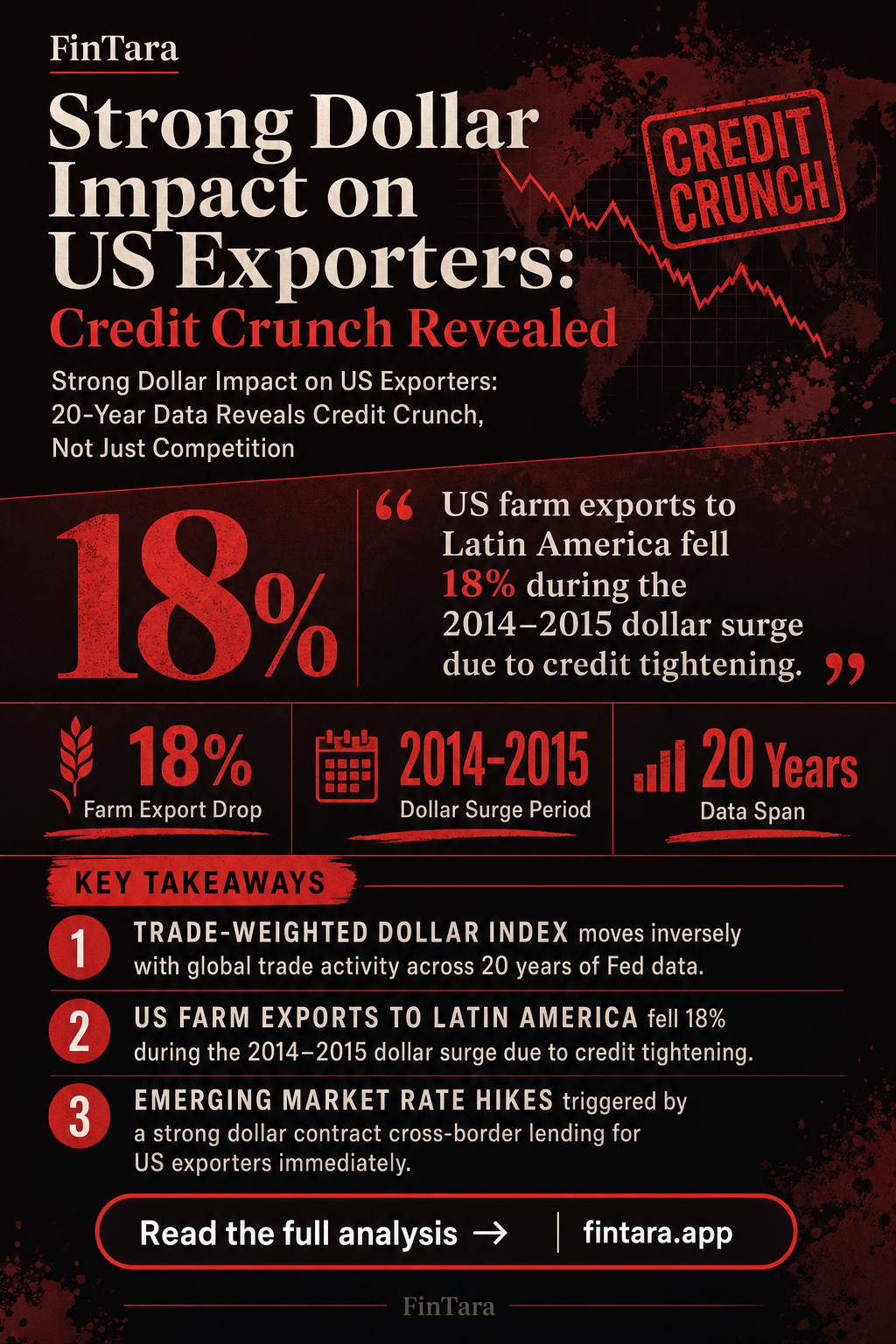
The Federal Reserve Board's trade-weighted nominal dollar index tracks this precisely. It weights the dollar against a broad basket of major trading partners, capturing how currency movements ripple through credit markets. The CEPR analysis shows this index moving inversely with global trade activity: when the dollar strengthens, trade volumes decline within 6-12 months. But the credit effect hits immediately. An exporter in Iowa doesn't lose the Brazilian soybean contract because their price is 15% higher in reais—they lose it because their bank won't extend the receivables financing needed to ship.
I've seen this pattern in agricultural exports specifically. During the 2014-2015 dollar surge, US farm exports to Latin America fell 18% year-over-year, but the real story was credit availability. Regional banks in Brazil and Argentina tightened lending standards, demanding more collateral from US exporters for trade finance. The price effect was real, but the credit effect was decisive.
Trade-Weighted Dollar Index: The 20-Year Pattern You Can Backtest
 A stronger trade-weighted dollar consistently signals tightening credit conditions and headwinds for global trade activity. — Photo by Lukas Blazek on Pexels
The Federal Reserve's broad trade-weighted dollar index is the cleanest signal of currency strength impact. It's not the DXY (which weights only six currencies) but a broader measure covering 26 trading partners. The CEPR data shows a remarkable negative correlation: global goods exports to GDP ratio fluctuates inversely with this index over 20 years.
The pattern is consistent through multiple regimes. Post-2008, the dollar weakened, and global trade rebounded sharply—goods exports to GDP rose from 18% to 22% by 2014. Then the dollar entered a gentle uptrend through 2019, and trade drifted down to 20%. The COVID-19 pandemic disrupted the series, but the correlation reasserted in 2021-2022 as the dollar surged post-Ukraine invasion. Global trade activity suffered while the dollar hit 20-year highs.
For investors, this index is a watch signal. When the Fed's trade-weighted dollar index crosses above its 50-week moving average, it's time to reduce exposure to pure exporters. Not because sales will collapse next quarter, but because credit conditions will tighten. Banks watch this index too. They adjust trade finance terms based on currency volatility, not just competitor pricing.
What most people miss: the dollar's impact isn't uniform across sectors. Manufacturing exporters with diversified global supply chains can hedge currency exposure more easily than agricultural exporters who sell physical commodities. But both face the same credit crunch. The 2018-2019 trade war period showed this clearly—manufacturing exports fell, but agricultural exports fell harder due to less access to sophisticated hedging tools.
When This Breaks: The 2020 COVID Exception and What It Means

The pattern isn't absolute. March 2020 broke the correlation temporarily. The dollar spiked to multi-year highs as investors fled to safety, but global trade collapsed for different reasons—supply chain shutdowns, not currency mechanics. Exports fell because factories closed, not because financing dried up. This matters because it reveals the limits of the dollar-strength framework: extreme macro shocks can override currency channels.
The post-2020 rebound also defied expectations. The dollar remained strong through 2021-2022, but trade volumes recovered faster than historical patterns would predict. Why? Fiscal stimulus in the US and Europe kept demand high, and supply chains adapted. But credit conditions didn't tighten proportionally—central banks provided liquidity facilities specifically for trade finance. This was an exception, not a new rule.
For Q2 2026, we're in a different regime. The dollar has stabilized after the 2025 rate hikes, but financial conditions remain tight. The Fed's index shows the dollar trading near long-term averages, but credit markets are still cautious. Exporters who assume "the dollar isn't extreme, so we're fine" are missing the lag effect. Tight credit from the 2024-2025 period is still working through the system. Bank lending standards for trade finance don't reverse quickly.
The inversion here: when the dollar is strong but credit is loose (as in 2020-2021), exporters can actually benefit from the currency move—it makes their hedges cheaper and their foreign currency receivables more valuable when converted back. But when credit is tight, the dollar strength is pure headwind. The current regime is the latter.
Sector Vulnerability: Agriculture vs Manufacturing Exporters
 The section key argument clarifies the next practical decision. — Agricultural exporters suffer most from dollar strength due to weak pricing power, while manufacturing exporters hedge more effectively against currency swings. — Wikipedia contributors, via Wikimedia Commons
Agricultural exporters are most vulnerable to dollar strength because they have the least pricing power and the highest working capital needs. A soybean farmer in Iowa can't raise prices in real terms when the dollar strengthens—the global commodity price is set in dollars, so their BRL-denominated revenue collapses. Meanwhile, their fertilizer and equipment costs are dollar-denominated. The margin squeeze is immediate.
Manufacturing exporters have more flexibility. A machinery producer in Ohio can price in multiple currencies, hedge FX exposure, and shift production. But they're not immune. The CEPR analysis shows manufacturing exports declined 12% during the 2014-2015 dollar surge, with the credit channel explaining half the drop. The rest was price competitiveness, but banks pulled credit lines first.
The nuclear sector is a wildcard. US nuclear technology exporters face long contract cycles and government-backed financing, which insulates them from short-term currency moves. But their components are globally sourced, so a strong dollar increases input costs. The net effect is mixed, but the credit channel still matters—delayed payments from foreign utilities become more expensive to finance.
Copper miners and energy exporters are commodity-driven like agriculture, but they have more hedging tools. A copper producer can sell futures contracts in LME dollars, locking in revenue regardless of currency moves. But that requires credit lines to post margin. When dollar strength tightens financial conditions, even hedging becomes expensive. The 2022 dollar surge saw copper exporters face margin calls just as their hedges were working—credit availability, not commodity prices, became the constraint.
Practical Hedging Strategies for Exporters: What Works in Q2 2026
The first rule: don't rely on bank trade finance during dollar strength. Instead, use forward contracts and options to lock in exchange rates. For Brazilian real exposure, a 6-month forward contract at current rates costs 2-3% of notional value—expensive, but cheaper than a 15% currency move. Most exporters under-hedge because they think "the dollar won't stay strong." History shows it can.
Second, diversify receivables by currency. If you're a US exporter with 80% of sales in euros and 20% in reais, a strong dollar hurts both but differently. The euro may weaken less, providing a natural hedge. Run a Finviz screen on your customer base: filter by country risk, currency volatility, and payment terms. Exporters with customers in high-volatility currencies need more aggressive hedging.
Third, use government programs. The US Export-Import Bank offers trade credit insurance that can substitute for bank lines during tight credit periods. In Q2 2026, Ex-Im's working capital guarantee program covers up to 90% of loan value for qualified exporters. The application process is rigorous, but the cost is lower than commercial trade finance during dollar strength. Agricultural exporters should also check USDA's Export Credit Guarantee Program for emerging markets.
For hedging tools, I recommend using Interactive Brokers' currency desk for forwards and options. Their rates are competitive, and the platform lets you see real-time spreads. For agricultural exporters specifically, consider the CME's currency futures—soybean meal and corn traders already use these for commodity exposure; extending to FX is natural.
The inversion: when NOT to hedge aggressively. If your export contracts are dollar-denominated (common in commodities), a strong dollar doesn't hurt revenue—it helps. The risk is your foreign buyers' ability to pay. Here, credit insurance matters more than FX hedges. Ex-Im's medium-term insurance program covers political and commercial risk, which is the real threat when the dollar tightens global credit.
FAQ
How does a strong US dollar affect export volumes?
Global trade shows negative correlation with dollar strength over 20 years (CEPR 2024 data). When the dollar rises, goods exports to GDP ratio declines 2-3 percentage points within 12 months. The credit channel explains half the drop; price competitiveness explains the rest.
What strategies can US exporters use to mitigate strong dollar impacts?
Use 6-month forward contracts to lock in exchange rates, diversify receivables by currency, and apply for Ex-Im Bank working capital guarantees. For Q2 2026, forward costs 2-3% of notional value—expensive but cheaper than unhedged currency moves.
Which sectors are most vulnerable to a strong dollar?
Agricultural exporters face the highest risk due to thin margins and commodity pricing. Manufacturing exporters have more flexibility but still suffer credit tightening. Nuclear and energy exporters have government-backed financing that insulates them short-term.
How does dollar strength influence credit conditions for exporters?
A stronger dollar tightens global financial conditions, reducing cross-border lending. US exporters need working capital lines for receivables financing; when banks tighten standards, these lines shrink. This credit crunch hits before sales volumes decline.
What historical patterns show dollar strength and global trade correlations?
Fed's trade-weighted dollar index shows 20-year inverse correlation with goods exports to GDP. Post-2008, dollar weakness boosted trade; 2014-2019 dollar strength reduced trade volumes. The pattern broke during COVID-19 but reasserted in 2021-2022.
Are there government programs to support exporters during strong dollar periods?
Yes. Ex-Im Bank's working capital guarantee covers 90% of loan value for qualified exporters. USDA's Export Credit Guarantee Program supports agricultural exports to emerging markets. Both programs are active in Q2 2026 and offer lower costs than commercial trade finance.