
Reading SEC Form 4 filings accurately matters for Colombian professionals tracking US stocks. Form 4 reports insider transactions within two business days. Understanding who files and what transactions trigger a filing prevents false signals. This post explains the form's structure, deadlines, and practical reading.
What SEC Form 4 reports
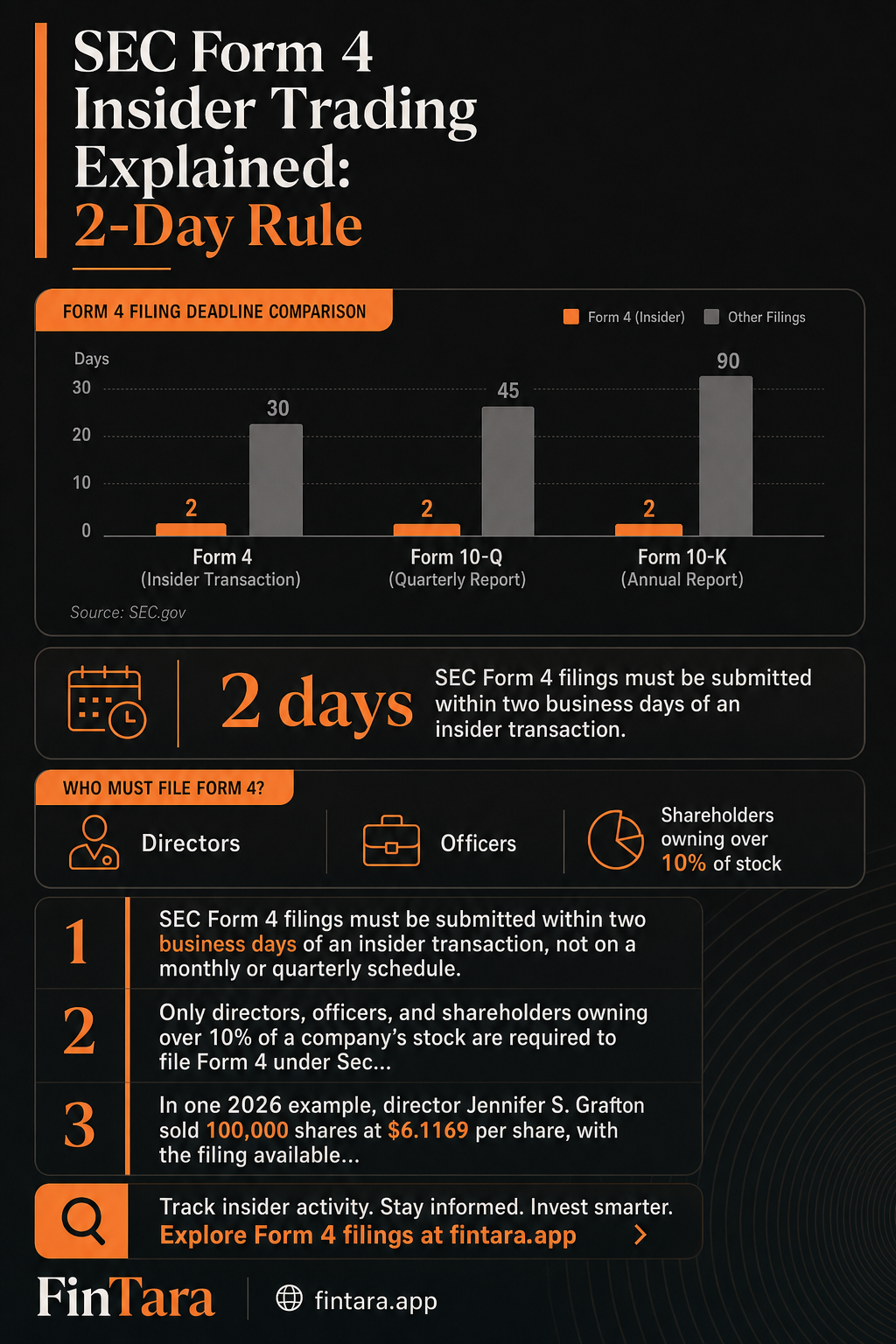
Form 4 is the official Statement of Changes in Beneficial Ownership required under Section 16(a) of the Securities Exchange Act of 1934. Corporate insiders must file within two business days after executing a qualifying transaction.
Directors, officers, and owners holding over 10% of company stock fall under Section 16 reporting rules. The form is submitted electronically through the SEC's EDGAR system, not by paper mail.
A 2026 director filing shows a sell of 100000 shares at 6.1169 on 2026-08-10, available in Grafton Jennifer S's Form 4.
Not every insider transaction is reportable; only open-market buys, sells, and certain derivative exercises trigger Form 4.
Why Colombian professionals often misread insider activity
 Misinterpreting legal insider sells as negative signals stems from overlooking ownership context and filing deadlines. — Photo by AlphaTradeZone on Pexels
Many Spanish-English speakers confuse insider trading with illegal activity, but Form 4 merely reports legal, disclosed transactions. Colombian professionals in finance frequently mistake a legal sell for a negative signal without checking the insider's total holdings or context.
Directors often sell shares for personal reasons, not to signal poor company fundamentals. A Colombian analyst might not account for the two-business-day deadline when assessing the timeliness of a filing.
The registration of a large sell like the 100000 shares on 2026-08-10 could look alarming without calculating the insider's remaining ownership percentage. Spanish-speaking professionals may overlook that only certain insiders like officers, directors, and >10% owners must report.
How to read a Form 4 filing step by step
 Specific fields on the document reveal insider transaction types, share prices, and resulting ownership levels. — Photo by AlphaTradeZone on Pexels
Start with box 1 on the form, which lists the reporting owner's name, address, and relationship to the issuer. Identify the security name and ticker symbol in table 1, usually a common stock or an option. Check the code in column 3: 'P' for purchase, 'S' for sale, or 'A' for an acquisition like a grant.
Review the transaction date in column 4 and the price per share in column 6 for consistency. Total shares owned after the transaction appear in column 9, giving current ownership context. A, a direct or indirect holding indicator matters for compounded complexity — insider may hold shares indirectly via a trust.
Deadlines, penalties, and common filing mistakes
Form 4 requires filing no later than the second business day after the transaction date, not calendar days. Late filings face SEC scrutiny and potential penalties under Section 16(a), including fines up to millions.
Common mistakes include missing a checkbox, entering wrong option codes, or failing to sign the form electronically. Complete the EDGAR submission via EDGAR's Login system, not email or hand delivery. Even a late Form 4 can be amended with a corrected submission, but it is still a disclosure violation.
Official Form 4 PDFs are available from the SEC website, not from broker platforms or unofficial aggregators.
Using weekly volume and scenario examples to build fluency
Filter EDGAR search by filing type '4' and one company, then review each reported transaction's code column to practice. A sample case: insiders at a tech company sell 5000 shares at $20.00 after a 20% run — a common pattern, not a panic.
Buy-back activity: management buys 2000 shares at $15 on a weak market day, usually signaling confidence. Option exercise with spot sell: insiders exercise 3000 options and immediately sell those underlying shares — neutral signal.
Practice reading the footnotes if the form is cryptic; they explain derivative conversions and indirect holdings.
FAQ
Who exactly is considered an insider for Form 4?
An insider includes any officer, director, or beneficial owner of more than 10% of the company's equity securities. Each role faces Section 16 reporting duties, but only insiders must file. The definition excludes regular employees without these titles.
If a Form 4 is filed late, does the SEC automatically fine?
Not always an automatic fine, but the collection of false or late forms can trigger enforcement actions. Penalties range from fines to forced disgorgement of profits. A practical compliance approach is to file within two business days and keep the responsibility average of the previous year.
Does every insider buy or sell require a Form 4?
No, only most open-market purchases and sales. Gifts, certain limited partnerships, and inherited shares may require alternative forms. For example, a restricted stock vesting uses Form 4, but a 10b5-1 plan sells still must be reported. Always check if the transaction is a Section 16 reportable one.
How can I quickly search for Form 4 filings for any company?
Use the SEC's EDGAR full-text and company search, entering the ticker in the 'Company name' field. Then filter filings by '4' under the transaction type menu to list recent insider activity. You can also search by name of the reporting office holder.
What is the practical difference between Form 3, Form 4, and Form 5?
Form 3 is the initial beneficial ownership report, filed when you first become an insider. Form 4 is your for each change in ownership, typically within two business days. Form 5 is the annual report for transactions that were not yet due.
How do I interpret a cash purchase by a director at a specific price?
Look at the form's column on the transaction price, like a 2026 buy at 5.60 for Ford stock. Whether it is a signal depends on the price relative to the 52-week range and the insider's total shares. The buy may signal confidence, but never treat the purchase as a guaranteed rise.