
Most retail investors think they're diversified because they own ten stocks or three ETFs. They're not. Real allocation means sizing positions deliberately — matching risk, time horizon, and goal to each dollar in the portfolio. What competes here isn't the concept of diversification; it's the execution. This post focuses on position sizing within an equity-heavy portfolio: how much to hold, where concentration costs you, and the one allocation mistake most retail investors repeat without realizing it.
Why "Spread It Around" Isn't the Same as Allocation
The instinct is understandable. Own more things, reduce risk. But owning fifteen stocks with 6–7% in each doesn't produce diversification — it produces a slow-moving index with higher tracking error and no particular thesis.
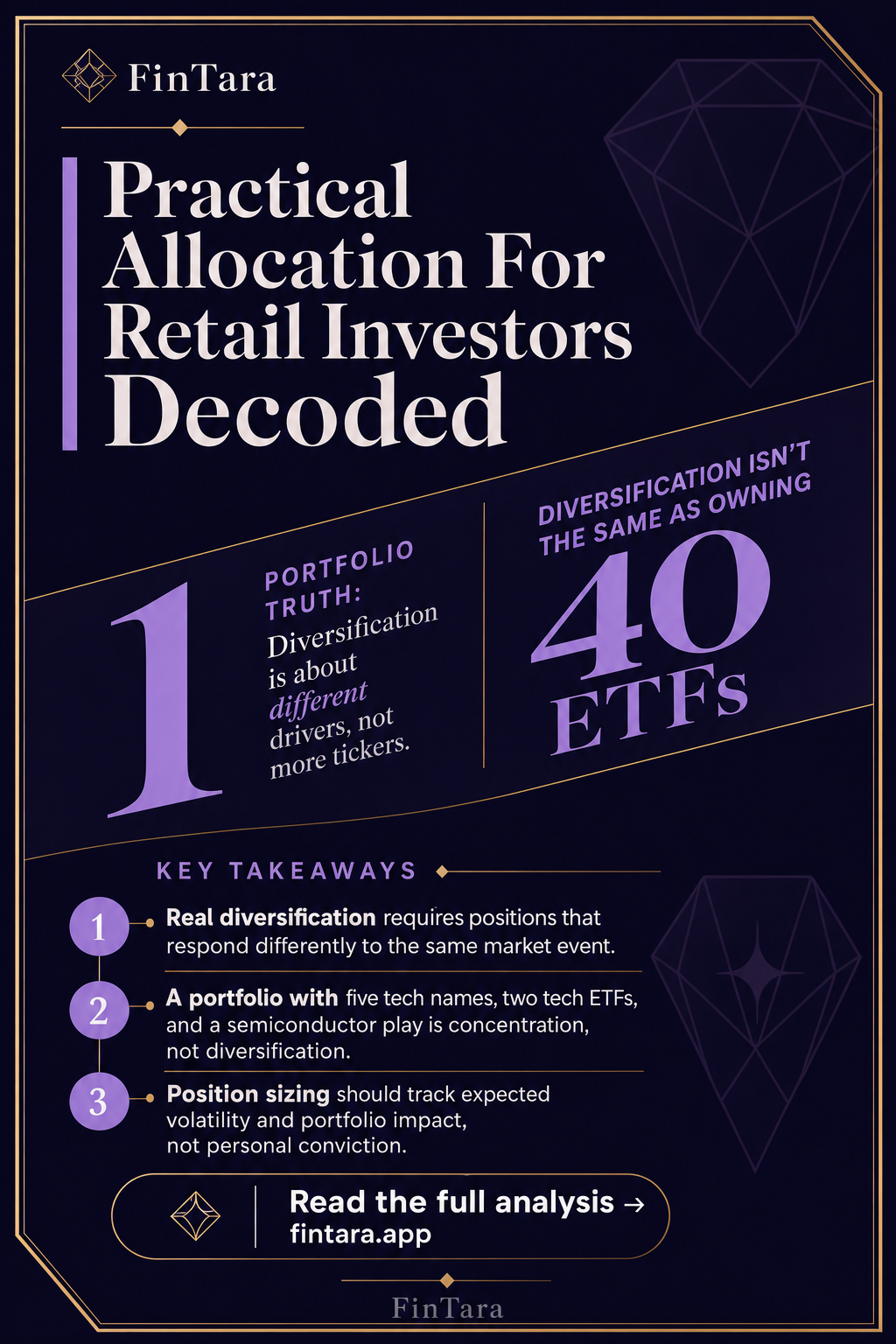
Diversification only works when the positions you hold respond differently to the same event. A portfolio with five tech names, two tech ETFs, and a semiconductor play isn't diversified. It's concentrated, just with extra steps.
Position sizing is where this confusion lives. Most retail investors choose weights by feel or by how confident they are in a name. Neither is a process. Confidence doesn't scale — you might feel 80% sure on three different names simultaneously, which tells you nothing about how large those positions should be relative to each other or to portfolio risk.
What does help: thinking in units of portfolio impact, not conviction. A position that can move 30% in either direction should be sized differently than one with 10% expected volatility — regardless of how much you like the story.
The Overconcentration Problem That Looks Like Normal Investing
 Winning positions naturally grow into oversized holdings through appreciation, creating drift-based concentration that can reverse violently. — Photo by www.kaboompics.com on Pexels
Here's the part most allocation guides skip. Single-stock concentration isn't just for people who got lucky with an IPO or inherited shares. It's the default outcome when retail investors run a portfolio without formal sizing rules.
It works like this: the positions you're most right about get large naturally — not because you sized them up deliberately, but because they appreciated. A 5% starting position in a stock that doubles becomes 9–10% of your portfolio without you touching it. Multiply that across two or three winners, and suddenly half your portfolio is in names you never explicitly decided to concentrate in.
That's drift, not strategy. And the problem with drift is that the same mechanism that creates concentration can unwind it violently. A stock that doubled can halve — faster than it rose.
The practical fix isn't to cap gains artificially. It's to set a maximum position size before you buy, and decide in advance at what threshold you rebalance or trim. You don't have to act on every percent move. But you do need a rule that triggers a decision before emotion does.
If you want to go deeper on where concentration actually goes wrong — not theoretically, but the specific decisions that create it — concentrated portfolio sizing 5 fatal errors covers the mechanics in detail.
When Rules-Based Sizing Breaks Down
 Rules-based position sizing can fail when investors misjudge conviction, underestimate correlations, and overlook how shared macro factors concentrate portfolio risk. — Photo by Kampus Production on Pexels
Position sizing rules give you a structure. They don't give you a result. That distinction matters.
The most common rules-based approach is equal weighting — hold twenty positions at 5% each, rebalance quarterly. It sounds clean. The problem is that equal weighting assumes you have equal insight into all twenty names. Almost no retail investor does.
The other popular framework: weight by conviction. Give your highest-conviction ideas the largest allocation. The failure mode here is well-documented — humans are poor at estimating the probability of being wrong on their best ideas. High conviction and high quality of analysis are not the same thing.
There's also the correlation problem that rules often ignore. Two positions can each be sized correctly on a standalone basis but still create portfolio-level concentration risk if they respond to the same macro factor. Energy stocks and industrial stocks looked uncorrelated in sector terms during the post-2020 rally — until commodity prices started driving both simultaneously. Sector labels don't capture actual correlation.
Rules work until the assumption behind the rule breaks. Equal weighting breaks when you have uneven edge across names. Conviction weighting breaks when your process for estimating conviction is flawed. Correlation assumptions break when macro regimes shift.
This doesn't mean abandon the rules. It means build in a review trigger: a market condition or time interval at which you audit whether the assumption underlying your sizing is still valid.
Building an Allocation Process That Survives Real Markets
 Resilient allocation processes prioritize drawdown limits and tier core positions based on genuine analytical capacity. — Photo by RDNE Stock project on Pexels
The allocation frameworks that hold up under pressure share one feature: they were built before volatility arrived, not during it.
Start with how much total equity risk your portfolio can absorb. That means thinking about drawdown, not just return. If a 25% portfolio decline would trigger panic selling or force a life change (spending a down portfolio to cover expenses), then sizing toward maximum equity exposure is wrong — regardless of your expected return.
From there, think in tiers:
Core positions — these are high-conviction, well-understood businesses or ETFs with broad exposure. They can be sized 10–20% each if you have real analytical depth on them. Most portfolios can support three to five core positions before the analysis per position starts to thin.
Satellite positions — these are opportunistic, thematic, or higher-volatility names. They should be sized 2–5% each. Not because you're less confident, but because the variance of outcomes is wider. If you're right, the position still contributes meaningfully. If you're wrong, it doesn't set your year back.
Watch list sizing — some retail investors hold positions in names they're still evaluating. That's fine. But "I'll watch how it performs" is not a sizing rationale. If a position doesn't have a thesis and a risk limit attached to it, it shouldn't be in the portfolio yet.
A few things that don't belong in the allocation conversation: How long you've held a position. Whether it's currently up or down. Whether "it'll come back." Those are anchoring traps, not allocation logic.
Rebalancing cadence matters too, but not in the direction most investors assume. More frequent rebalancing does not mean more control — it often means more friction, more taxable events, and more second-guessing. An annual or semi-annual review tends to be sufficient for most retail portfolios. The exception: when a single position breaches your preset maximum weight due to appreciation. That's a trigger event, not a calendar event.
For a closer look at how sizing decisions interact with portfolio-level risk across specific scenarios, concentrated portfolio sizing 5 fatal errors walks through what goes wrong when the tier structure gets ignored.
When to Run a Concentrated Portfolio — and When Not To
Concentration isn't inherently wrong. It's wrong without awareness. Some of the best long-run outcomes in equity portfolios came from investors who held five to eight positions with high conviction and the patience to stay through volatility. That's not reckless — it's a deliberate trade-off: deeper analysis on fewer names, accepting the volatility that comes with it.
The concentrated approach requires one thing most retail investors underestimate: the ability to hold through a 40–50% drawdown on a position without selling. That's not a psychological nicety — it's a practical requirement. A position you'd sell at minus-30% should never be sized as if you'd hold it through minus-50%.
The times NOT to concentrate:
When your analytical edge on the position is uncertain. "I've read the 10-K" is not an edge. Genuine edge looks like a differentiated view on an underappreciated catalyst, a misread on future revenue mix, or a structural cost advantage the market hasn't priced. Absent that, diversified index exposure will almost certainly serve you better.
When your time horizon compresses. A three-year portfolio with concentrated equity exposure carries real sequence-of-returns risk. If you need to access the capital, concentration becomes a liquidity problem as well as a volatility problem.
When you're building, not compounding. Investors in the accumulation phase — regularly adding capital — tend to benefit more from diversified exposure because new contributions smooth the entry price across market conditions. Concentration is a harvesting strategy, not an accumulation one.
FAQ
How many positions should a retail portfolio hold?
There's no universal number, but research on marginal diversification benefits suggests returns from adding positions flatten out past 20–25 stocks. Below fifteen positions, idiosyncratic risk rises sharply. Most self-directed retail portfolios with genuine analytical capacity sit comfortably between 15 and 25 names — beyond that, the analysis-per-position quality usually drops.
Is an equal-weight ETF better than market-cap-weight for retail investors?
Equal-weight ETFs like RSP (the S&P 500 equal-weight version) historically outperformed the market-cap version over full market cycles, largely from the small-cap tilt. The trade-off: higher turnover, slightly higher expense ratios, and underperformance during periods when mega-cap growth dominates — which describes 2023 and 2024 in full.
How does time horizon actually change position sizing?
A 20-year horizon tolerates drawdowns differently than a 5-year one — not just emotionally, but mechanically. A longer horizon lets compounding recover losses. On a 5-year horizon, a 40% drawdown in year two leaves less time to recover. That changes how large any single volatile position should be, independent of your return expectations.
What's the right cash allocation for a self-directed portfolio?
Cash allocation in an equity portfolio is mostly a timing buffer, not a return driver. The useful range is enough to fund 6–12 months of expected withdrawals plus dry powder for opportunistic buys — typically 5–15% of total portfolio value. Holding more than 20% in cash on a long time horizon is almost always a drag, not a hedge.
Should sector exposure factor into sizing decisions?
Yes — and it's the one dimension most retail investors skip. Two positions in different companies can behave like one position if they're both levered to the same macro driver. In Q2 2026, AI infrastructure exposure is particularly dense across semiconductors, cloud names, and select industrials. Mapping your portfolio by factor exposure, not just sector label, gives you a cleaner picture of real concentration.
Diversification is not about owning more things. It's about making sure the things you own don't all fail at the same time — and sizing each one so that when it does fail, it doesn't take the portfolio with it.