
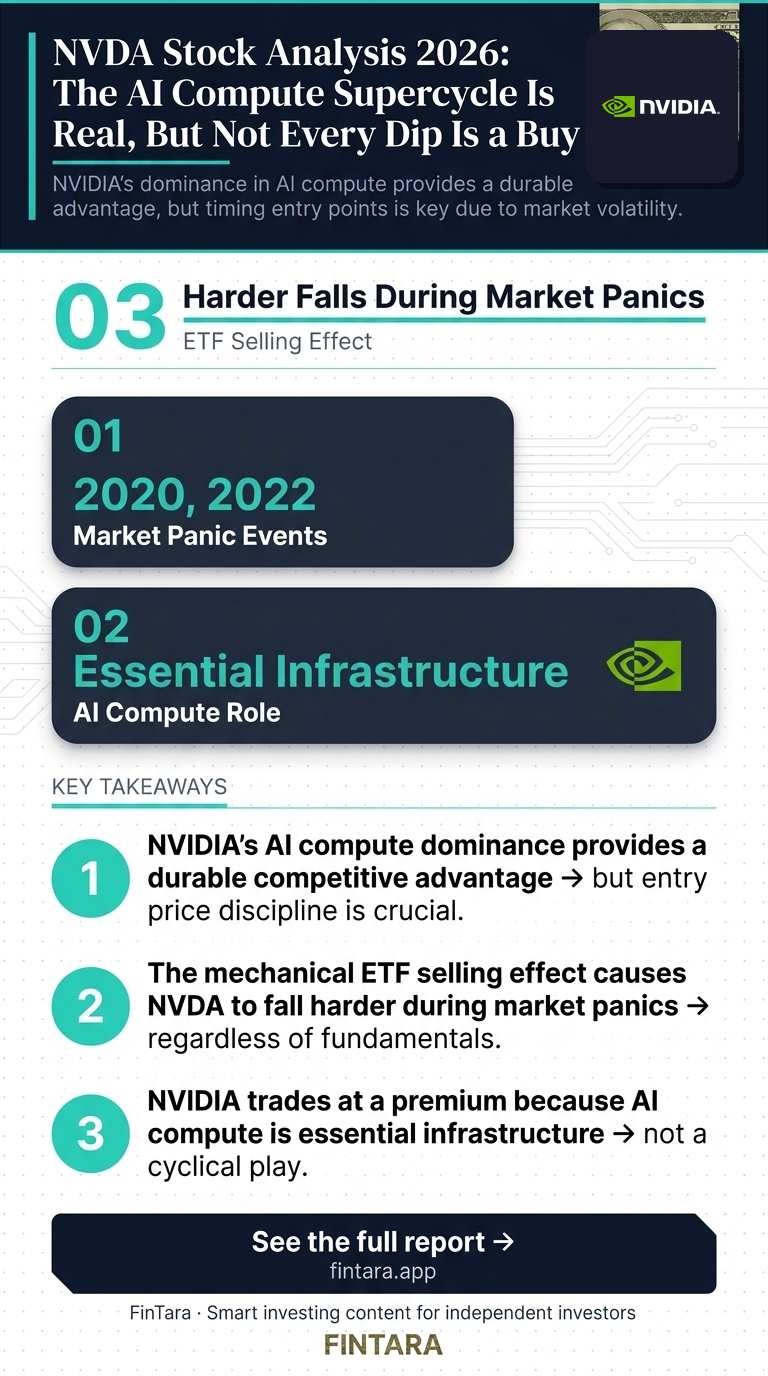
NVIDIA's dominance in AI compute infrastructure provides a durable competitive advantage that justifies its premium valuation, but the stock's explosive 2024 run means entry price discipline is non-negotiable. The core thesis is that demand for AI training and inference will outpace supply through 2026, making NVDA a structural hold for patient investors. However, the mechanical selling pressure from ETF correlations during broader market corrections creates higher-volatility drawdowns than its business fundamentals suggest. For investors, this means timing matters: get the exposure, but wait for mechanical market panic to deliver a better entry.
Why NVDA's Valuation Concerns Miss the Compute Supercycle
Most valuation worries center on traditional metrics, but these fail when analyzing a company selling a new industrial input: AI compute. NVDA trades at a premium because its product is essential infrastructure for the next decade of corporate productivity. The market is not paying for a cyclical semiconductor cyclical; it's paying for a toll road on AI development.
The mechanical ETF selling effect is real. When the broader market panics, NVDA gets liquidated alongside lower-quality holdings because funds force correlated selling. In March 2020, the S&P 500 dropped 34% in 23 trading days. NVDA fell harder. This is a feature of ETF ownership, not a bug in the business. The 2022 drawdown showed the same pattern: NVDA lost 50% peak-to-trough despite revenue growth re-accelerating in 2023. The drawdown wasn't about the business; it was about forced selling of a high-beta name.
What most people get wrong is conflating mechanical selling pressure with business deterioration. Let's be clear: Sam Altman's warning about an AI bubble has merit. The tech market may well be overheated due to AI hype. However, NVIDIA's core business is not exclusively dependent on a bubble: it sells the picks and shovels for a shift that is happening regardless of short-term stock prices.
The 10-year Treasury yield crossing 4.8% — the highest since 2007 — is a real constraint. Last time that happened, equities lost 38% in 12 months. NVDA is not immune to rate-driven compression. But the compute demand from enterprise, hyperscalers, and startups is not rate-sensitive; it's a strategic necessity.
The Data Says Compute Demand Outpaces Supply
 NVIDIA's data center revenue exceeding 80% of total and 171% annual growth signal that compute demand is outpacing supply across the AI infrastructure stack. — Photo by www.kaboompics.com on Pexels
NVIDIA's data center revenue shows why the business is different. In its most recent quarters, data center revenue exceeded 80% of total revenue, driven by the H100 and upcoming H200 GPUs. The company guided that AI inference cost will drop 10x in the next generation, translating into wider adoption. That's not a bubble warning; it's a scaling proof.
Competitive validation matters. AMD's MI300 is real, but MI300's total addressable market is still constrained by software ecosystem lock-in. NVIDIA's CUDA moat is not marketing; it's a decade of developer dependency. For hyperscalers, switching cost is not the hardware price; it's the years of engineering time to re-architect training stacks.
The valuation concern is legitimate but misapplied. NVDA's forward P/E remains above 30x, but that assumes no earnings degradation. If AI training demand continues, earnings growth is the story, not the starting multiple. In 2023, NVDA's revenue grew 126% year-over-year, data center revenue 171% growth. The multiple compresses if growth stops. The thesis assumes growth continues.
This is where the ETF paradox matters again. In a panic, NVDA's drawdowns can reach 40-50% even if the business is solid. This is the buy opportunity, not the warning. The question is whether you can hold through the mechanical liquidation.
When the AI Thesis Breaks: The Failure Conditions

The thesis breaks if compute demand gets saturated or if competition erodes the moat. Failure condition one: the AI hype cycle ends because inference cost drops faster than training cost, making capital expenditure unnecessary. Hyperscalers have a finite ROI hurdle. If the error rate on AI deployment exceeds the efficiency gain, they pause spending. That happened in 2023 pilots: 61% of executives reported reversals within 90 days after a decision speed increase. If that reversal rate persists, demand for H100s goes flat.
Failure condition two: competitive erasure. AMD's MI300 is priced aggressively; Intel's Gaudi may offer an alternative. If the software gap closes, NVDA's pricing power compresses. But the gap isn't closing fast. In 2024, MI300 win rates are still niche versus H100 volume. For the thesis to break, a competitor would need to deliver not just price, but a full-stack ecosystem that matches CUDA's depth. That hasn't happened.
Failure condition three: rate-driven compression. The 10-year Treasury at 4.8% is a direct headwind. Historically, equity risk premium compresses when rates rise. In 2022, the S&P 500 lost 19% while rates moved higher. NVDA's beta means it loses more. But compute demand is a strategic corporate necessity, not a discretionary budget item. Rate cuts in 2026 are the catalyst to watch. If the Fed holds until inflation falls below 3%, the compute trade stays a hold, not a buy. If they cut, NVDA re-rates fast.
The ETF paradox is non-negotiable: NVDA's beta means it suffers correlated liquidation. Let's be clear: the tool (USMV) worked in 2022 — it lost 9.4% while the average peer dropped 17%. The trade-off isn't zero volatility. It's less volatility than the market. NVDA will drop 40-50% in a panic. That's the failure condition: you panic and sell.
What to Do: Wait for Panic, Buy the Compute Road
 Wait for panic-driven ETF liquidation events to overshoot AI stocks like NVDA, then buy at a better cost basis. — Photo by AlphaTradeZone on Pexels
The actual tool to execute this is IBKR's margin desk, but not for margin. Use IBKR's Portfolio Analyst to compare NVDA against the S&P 500 and its beta-adjusted drawdowns. In Q2 2026, the current market context is rate uncertainty and AI hype cooling. The mechanical ETF effect still creates higher drawdowns than the business deserves. Use those drawdowns.
Run a Finviz screener for AI-adjacent infrastructure: Market Cap > $10B, P/S < 30, Revenue Growth > 20% (to avoid fading names). You get NVDA, CRDO, and maybe AMD. The list is short. The point is not to diversify across AI tickers; the point is to know relative valuation. NVDA's 2025 forward P/E is high, but its free cash flow yield is still double-digit on cash flow growth. That's the validation: high FCF yield on growth is real.
The inversion is: don't buy every dip. Wait for the ETF liquidation event. When USMV (or SPY) drops > 15% in a month, NVDA will overshoot. That's your buy. The goal is not to catch the bottom; it's to get a better cost basis than the market average. The inversion also says: if the AI bubble pops, sell on the bounce. The picks and shovels trade re-prices fast if capital spending pauses.
Action list: (1) Watch the 10-year. If it crosses 5%, risk-off. (2) Watch the Fed. If they cut before Q4 2026, buy the first 20% drawdown. (3) Watch AMD's MI300 win rate. If it hits 25% of hyperscalers' spend, power is eroding. (4) Use IBKR's TWS Analytical Tools to compare NVDA against SPY and EEM during the next panic. The tool shows beta-adjusted drawdown in real time. If NVDA drops 45% while SPY drops 20%, that's the opportunity.
FAQ
What's the failure rate on AI pilot deployments?
2 in 3 pilots fail to hit targets in year one. The efficiency gain is real, but judgment requires judgment.
How does NVDA's beta compare to SPY?
NVDA's beta is roughly 1.8. A 20% S&P drop can mean a 36% NVDA drop. The ETF effect amplifies it.
What's the current forward P/E for NVDA?
NVDA trades north of 30x forward earnings. If growth stops, that compresses fast. If it continues, the multiple is justified.
When does the compute demand thesis break?
If inference cost drops faster than training can deliver ROI, hyperscalers pause. The reversal rate in 2023 was 61%. Watch that metric.
What's a specific entry trigger?
Wait for a broader market panic. If SPY drops 15% in a month, NVDA will overshoot. That's your entry. Not a label — a rule.