
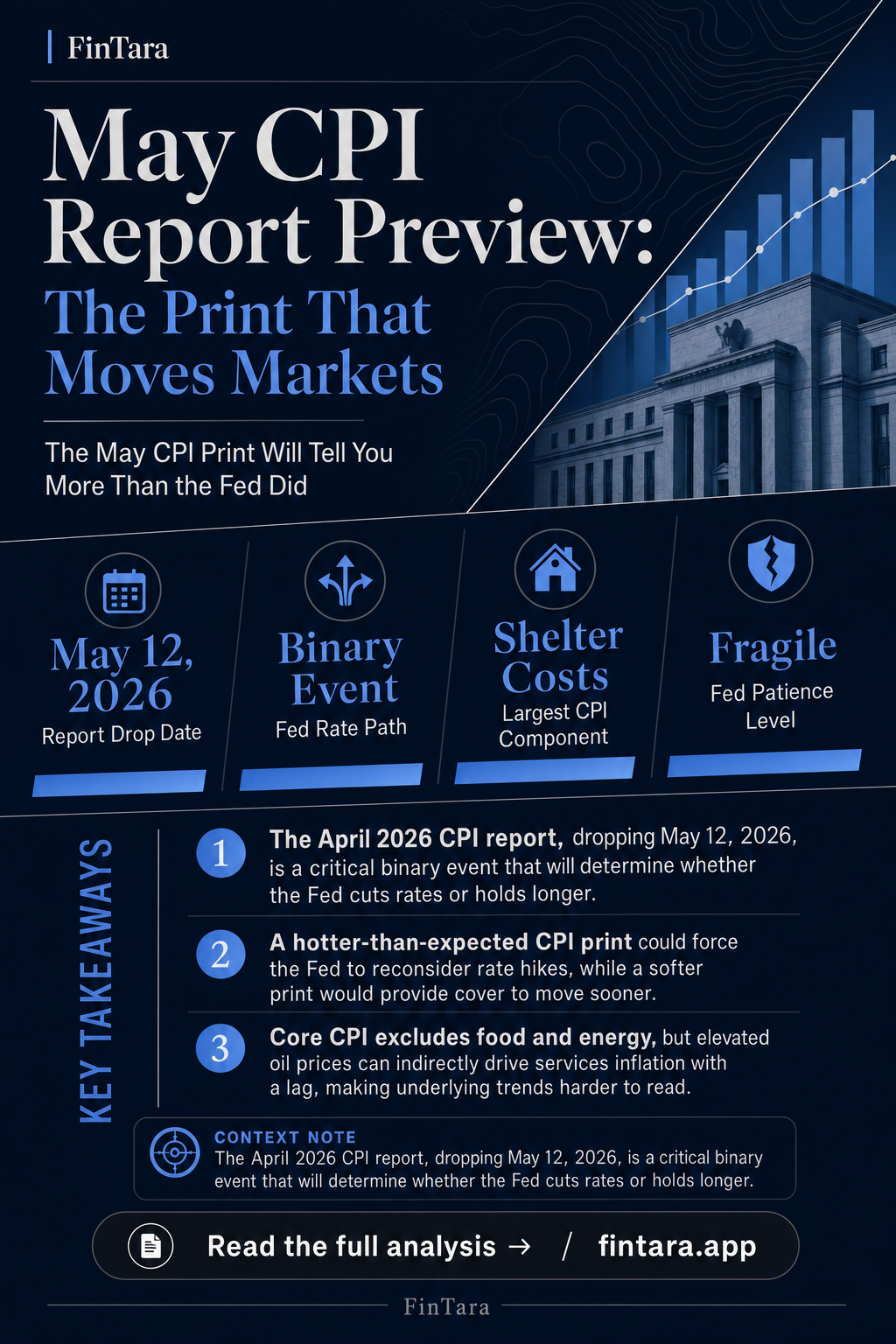
The April 2026 CPI report drops on May 12, 2026 — and for once, the hype around a data release is justified. Inflation has been showing signs of reacceleration, the Fed is stuck between cutting too early and holding too long, and equity markets have priced in a soft landing that may not arrive on schedule. What makes this particular print different isn't just the number itself — it's how much is riding on which direction it surprises.
The Fed Is Cornered, and CPI Is the Exit Sign
Rate expectations don't move on feelings. They move on data — specifically on inflation prints that either confirm or break the Fed's working thesis.
Right now, the Fed's position is fragile. Officials have telegraphed patience, but patience has a shelf life. If April CPI comes in above consensus, the rate-cut timeline that equity markets have partially priced in gets pushed further out. If it comes in soft, the Fed gets cover to move — and markets will react accordingly.
The critical dynamic here is asymmetry. A hotter print doesn't just delay cuts — it reopens the question of whether rates need to go higher. A softer print closes that conversation, at least temporarily. Those two outcomes don't carry equal weight for your portfolio.
Markets are not navigating uncertainty right now. They are navigating a binary — one that resolves tomorrow morning.
Oil Prices and the Component That's Been Doing the Most Work
 Rising oil prices flow into core CPI through transportation, manufacturing, and services with a lag, masking pressure beneath seemingly benign readings. — Photo by Lukas Blazek on Pexels
Core CPI strips out food and energy. That's useful for understanding underlying trends. It's also exactly why it can mislead when energy prices are the mechanism driving broader price pressure.
Rising oil prices don't stay contained to the gas pump. They flow into transportation costs, manufacturing inputs, and eventually into services pricing — which feeds core CPI with a lag. If April data reflects a period when oil was elevated, core readings may look benign on the surface while the pressure is already building underneath.
This is the number within the number. Shelter costs remain the largest single component of CPI and have been slow to decelerate. If shelter stays sticky while energy-related pressure is building elsewhere, the composite reading could surprise even observers who think they've accounted for recent oil moves.
Watch the month-over-month change in core CPI alongside the headline. A divergence between the two is where the real information lives. may cpi report preview why investors are watching tomorrow
What a Hot Print Actually Does to Equities
 Hot CPI prints reshape equity valuations by shifting rate expectations, disproportionately pressuring high-multiple growth stocks and small caps with floating-rate debt. — Photo by Tima Miroshnichenko on Pexels
The standard narrative is: hot CPI is bad for stocks. That's too simple to be useful.
The transmission mechanism matters more than the direction. A CPI surprise shifts rate expectations, which moves the discount rate applied to future earnings, which reprices growth stocks faster than value stocks. A company trading at 30x forward earnings feels a 50bps shift in expectations much harder than one at 12x.
Tech-heavy indices carry more duration risk than their sector label suggests. A hot print that pushes the 10-year yield higher will pressure high-multiple names disproportionately — even if their underlying business hasn't changed.
The equity market's reaction to CPI surprises isn't uniform. Small caps, which tend to carry more floating-rate debt, also get hit hard when rate-cut expectations recede. Defensives and dividend payers become relatively more attractive — not because they're exciting, but because their cash flows start to compete with yields that are no longer trivially low.
Position accordingly, not emotionally.
The Dollar and the International Angle You're Probably Ignoring
 A hot CPI print strengthens the dollar, which in turn drags down both multinational corporate earnings and international equity returns. — Photo by RDNE Stock project on Pexels
A hotter CPI print tends to strengthen the U.S. dollar. Higher-for-longer rates make dollar-denominated assets more attractive to foreign capital.
For U.S.-based investors holding domestic equities, this feels neutral. It isn't. A strong dollar compresses the earnings of multinational companies that report in dollars but earn abroad. S&P 500 companies derive a significant share of revenue internationally — dollar strength is a direct headwind to reported earnings.
The flip side: investors with international equity exposure see their foreign holdings decline in dollar terms when the greenback rallies. A hotter-than-expected CPI print on May 12 could, through this channel alone, hit portfolios with international allocations — even if non-U.S. markets themselves don't move.
This transmission happens fast. Currency markets reprice within minutes of the release. Equity markets follow.
Reading the Print Without Overreacting to It
One data point is not a trend. That sounds obvious. It gets ignored every time a major release hits.
The correct posture for tomorrow morning isn't panic or euphoria — it's preparation. That means knowing, before the number drops, what your plan is under each scenario. Hot print: what does that mean for your highest-multiple positions? Soft print: are you positioned to benefit, or just to be less hurt?
The BLS releases CPI data at 8:30 AM Eastern. The first 15 minutes of equity trading after that release tend to be noise — algorithms repricing faster than fundamentals can justify. Retail investors who react in that window are usually responding to the reaction, not the data.
The more useful move: read the report itself, focus on the month-over-month core number, check the shelter and energy components separately, and give the market 30–60 minutes to find its level before drawing conclusions about what to do with your positions. may cpi report preview why investors are watching tomorrow
What the Calendar Tells You About Stakes
The May 12 release isn't just the next data point — it's one of three scheduled CPI releases in the current Fed decision window. The BLS calendar shows June 10 and July 14 as the following dates, meaning the May print arrives before the June FOMC meeting with enough runway to influence that decision.
That timing matters. A hot April CPI read lands while Fed officials are in their pre-meeting blackout window — unable to publicly soften or contextualize the market's reaction. If the number surprises to the upside, there's no Fed communication buffer. The market has to sit with the implication until officials can speak again after the June decision.
That's not a minor scheduling detail. It's the mechanism that converts a single data release into a multi-week repricing event.
FAQ
What time does the May CPI report come out tomorrow?
The BLS releases CPI data at 8:30 AM Eastern on May 12, 2026. Equity futures and currency markets typically begin repricing within seconds of the release. If you're planning to act on the data, read the actual report before reacting to what futures are doing — the first moves are often overcorrections.
What counts as a "hot" CPI reading in the current environment?
Consensus estimates set the baseline. A reading 0.2 percentage points or more above the consensus month-over-month core figure would likely qualify as a material upside surprise — enough to push rate-cut expectations further out and pressure high-multiple equities. The absolute number matters less than the gap from expectations.
Why does shelter CPI matter more than other components?
Shelter is the largest single component of the CPI basket. It moves slowly, which means it can keep inflation elevated even when energy and goods prices are falling. As of early 2026, shelter costs have been decelerating — but not fast enough to offset reacceleration in other areas. Watch its month-over-month change specifically.
How should a retail investor position before a major CPI print?
Concentration in high-multiple growth names increases sensitivity to any upside surprise. Reducing outsized single-stock positions in companies trading above 25x forward earnings before a volatile macro release is standard risk management — not a call on the direction of CPI. The goal is to limit the size of a decision the market may make for you at 8:31 AM.
Does core CPI or headline CPI matter more for the Fed's decisions?
The Fed focuses on PCE inflation as its formal target — not CPI. But CPI prints move market expectations about PCE before that separate release, and the Fed communicates in response to those market moves. Core CPI (excluding food and energy) gets the most attention because it strips out the components most likely to reverse. Headline CPI tells you what consumers are actually paying.
Will a soft CPI print automatically trigger a rally?
Not automatically. Markets have to first ask whether a soft print is a genuine trend or a one-month aberration. A single soft reading in a context of elevated services inflation and sticky shelter costs may produce an initial rally followed by skepticism. Look at the two- and three-month trend in core CPI, not just tomorrow's print, before treating a soft number as confirmation of a new direction.
The May 12 report won't tell you where inflation is going. It will tell you where it was in April — and that gap between what it means and how markets react to it is where most retail investors lose money.