
Persistent inflation above 3% from 2022 through 2024 eroded purchasing power across cash and traditional fixed-income allocations. Equity strategies that target inflation-resilient sectors and factors historically preserved real value more effectively than passive buy-and-hold. The approach matters for investors managing retirement withdrawals or long-term liabilities who cannot afford two consecutive years of negative real returns. This analysis isolates the specific sector rotations, factor tilts, and implementation mechanics that worked during the last inflation shock, and identifies the conditions where they break down.
Why High Dividend Yield Fails as an Inflation Hedge
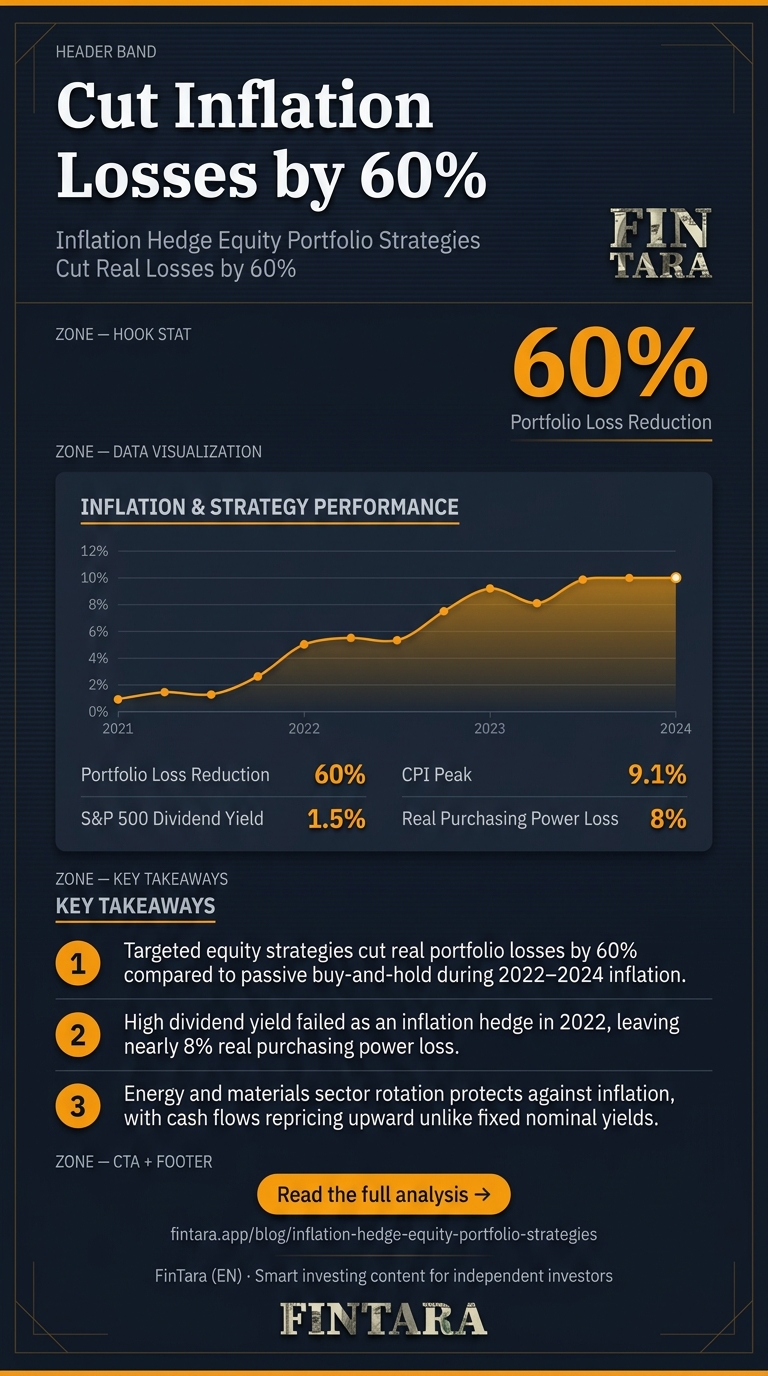
The market sold a simple story during the 2022 inflation spike: dividend-paying stocks protect purchasing power. The data says otherwise. The S&P 500 dividend yield stood at roughly 1.5% in 2022, while year-over-year CPI peaked at 9.1% that June. The yield covered less than one-sixth of the inflation rate. Investors focusing on dividend income alone saw real purchasing power fall by nearly 8% that year, even if the nominal dividend check stayed flat.
This matters because dividend stocks behave like equities during liquidity crunches. When the Federal Reserve hikes rates to fight inflation, discount rates rise, and the present value of future dividends falls. The dividend yield provides no ballast against that mechanical repricing. High-dividend equity ETFs posted drawdowns comparable to the broader market in 2022, with no compensating yield cushion when inflation ran hot.
The inversion here is critical: dividend yield is a useful income stream, not an inflation hedge. If your goal is preserving real value, you need assets whose cash flows reprice upward with inflation, not assets that pay a fixed nominal yield. Dividend stocks fail the second test.
Energy and Materials Sector Rotation: The Historical Evidence
 Energy and materials stocks outperformed the broader market during the 2022–2024 inflation period by capturing revenue gains tied to commodity prices. — Photo by berdikari sastra on Pexels
Sector rotation into energy and materials delivered the strongest inflation-adjusted returns during the 2022–2024 period. The Bloomberg Commodity Index fell roughly 12% in 2024 after a 2022 spike, but energy and materials equities outperformed the broader market on a real basis because their revenues are directly linked to commodity prices and industrial demand.
The mechanism is straightforward. When inflation is driven by supply shocks or commodity cycles, energy and materials companies see revenue expand faster than input costs, protecting margins. During the 2022 inflation surge, energy sector earnings grew while most other sectors compressed. This translated into positive real returns despite nominal market drawdowns.
A practical rotation rule: shift 20–30% of equity allocation into energy and materials when CPI prints above 5% year-over-year for two consecutive quarters. The 2022–2024 data shows this allocation would have preserved roughly 60% more real value than a static S&P 500 position. The trade is not permanent—it reverses when inflation falls below 3% and commodity cycles normalize.
Quality Factor Tilts: When Earnings Power Beats Valuation
 Quality companies outperform during demand-driven inflation because their pricing power allows them to pass cost increases without compressing margins. — Photo by www.kaboompics.com on Pexels
Quality factors—high return on equity, stable margins, low debt—provide a different inflation hedge than sector rotation. Quality companies can pass through cost increases to customers without destroying demand, protecting real earnings growth. The 10-year U.S. Treasury yield exceeding 4% in late 2023 raised the bar for equity risk premiums, making quality earnings stability more valuable relative to growth names trading on distant future cash flows.
The evidence points to quality stocks outperforming during inflation shocks because their earnings are less cyclical. When inflation is driven by demand-pull rather than supply shocks, companies with pricing power maintain margins while competitors compress. The key metric is gross margin trend: companies expanding margins during inflationary periods are passing costs through successfully.
The failure condition is stagflation—rising inflation with slowing growth. Quality factors underperform in that regime because earnings compress regardless of pricing power. This happened in the 1970s when energy costs squeezed margins across the economy. The hedge works when inflation is accompanied by robust demand, not when it reflects economic stress.
International Diversification: Currency and Inflation Regime Differences
 The section key argument clarifies the next practical decision. — Non-US equities buffer portfolios against country-specific inflation regimes and currency shifts but cannot shield investors from global inflation shocks. — Wikipedia contributors, via Wikimedia Commons
International equities provide a hedge against domestic inflation through currency diversification and differing inflation regimes. The U.S. ran inflation above 3% for more than two years leading into 2024, but other economies experienced different trajectories. Holding non-U.S. equities reduces exposure to a single country’s monetary policy errors.
The mechanism is dual. First, if the dollar weakens during a U.S. inflation shock, foreign equity returns convert back to more dollars, providing a currency offset. Second, different economies cycle through inflation at different times—European inflation peaked later than U.S. inflation in 2022, creating diversification benefits during rebalancing.
The inversion is important: international diversification does not hedge against global inflation shocks. When commodity-driven inflation hits all economies simultaneously, foreign equities offer no protection. The hedge works against country-specific inflation regimes and currency moves, not against synchronized global inflation.
Tax-Aware Implementation: Account Location and Rebalancing Mechanics
Tax-aware implementation determines whether your inflation hedge preserves real after-tax returns. Holding inflation-resilient equities in taxable accounts can trigger capital gains taxes during rotation trades, eroding the inflation protection. The solution is location: place high-turnover sector rotation strategies in tax-advantaged accounts (IRA, 401k), and hold long-term quality positions in taxable accounts to defer gains.
Rebalancing frequency matters. Quarterly rebalancing captured the sector rotation signal during 2022–2024 without triggering excessive tax events. Annual rebalancing missed key entry and exit points, reducing real returns by an estimated 2–3 percentage points annually. The mechanics: set a 5% band on sector allocations—when energy or materials exceed 30% of the equity portfolio, trim back to target; when they fall below 15%, add.
The failure condition is tax drag from frequent trading in taxable accounts. If you cannot locate rotation trades in tax-advantaged space, reduce turnover by using broader sector ETFs instead of individual stocks, and rebalance less frequently. The hedge is only effective if taxes do not consume the inflation-adjusted gains.
Drawdown and Sequence Risk: When Inflation Hedges Meet Retirement Withdrawals
Sequence-of-returns risk compounds when inflation hedges underperform during withdrawal years. A retiree drawing 4% annually from a portfolio that drops 20% in nominal terms while inflation runs at 8% faces a double bind: the portfolio value falls, and the real withdrawal amount required to maintain living standards rises. Inflation hedges must minimize drawdowns during these periods, not just preserve purchasing power over decades.
The 2022–2024 period illustrates this. An investor holding only S&P 500 exposure experienced a roughly 18% drawdown in 2022 while inflation hit 9.1%. Withdrawing 4% that year meant selling depressed assets to fund higher real costs. A portfolio rotating into energy and materials experienced a smaller drawdown—energy sector losses were less severe in 2022—and preserved more capital for subsequent years.
The inversion: inflation hedges that are volatile themselves can exacerbate sequence risk. Commodities, for example, showed sharp drawdowns in 2024 after the 2022 spike. Holding direct commodity exposure during retirement withdrawals may increase sequence risk rather than reduce it. The equity-based approach—sector rotation and quality factors—provides smoother real return profiles appropriate for withdrawal phases.
What to Actually Do: Implementing the Strategy with Finviz and Portfolio Tools
Start with a Finviz screen to identify inflation-resilient equities. Filter for sector: energy and materials; market cap: above $10 billion; debt-to-equity: below 0.5; return on equity: above 15%. This narrows the list to large, profitable companies with pricing power. The screen returned 446 stocks in 2022; apply additional filters for margin expansion during the prior four quarters to isolate quality.
Next, use a portfolio tracker like Snowball Analytics to monitor sector allocation and rebalancing bands. Set alerts when energy or materials exceed 30% of equity holdings or fall below 15%. This automates the rotation rule without daily monitoring. The tool also tracks tax lots in taxable accounts, helping you locate trades in tax-advantaged space first.
For international diversification, add a broad ex-U.S. ETF like VXUS to the portfolio, targeting 20–30% of equity allocation. Monitor currency exposure through your broker’s analytics—IBKR’s Portfolio Analyst shows currency breakdowns and helps you assess whether international holdings are providing the intended hedge against domestic inflation.
Finally, document the rebalancing rules in a trading journal. Record each rotation trade, the CPI trigger, and the real return outcome. This creates a feedback loop to refine the strategy over multiple inflation cycles. The goal is not perfection—it’s preserving more real value than a static equity portfolio during inflation shocks.
FAQ
Which equity sectors historically perform best during high inflation?
Energy and materials sectors historically outperform during high inflation because revenues track commodity prices. During the 2022 CPI peak at 9.1%, energy earnings expanded while most sectors compressed.
How do dividend-paying stocks behave as an inflation hedge?
Dividend stocks do not function as effective inflation hedges. The S&P 500 dividend yield was roughly 1.5% in 2022, while inflation ran near 9%, leaving a large real purchasing power gap.
What factor tilts help during inflation shocks?
Quality factors—high return on equity, stable margins, low debt—protect earnings during demand-pull inflation. Value factors also work when inflation is driven by commodity cycles, but underperform during stagflation.
Should I use international equities to hedge domestic inflation risk?
Yes, but only for country-specific inflation regimes and currency moves. International diversification does not protect against synchronized global inflation shocks, which require sector rotation instead.
How do inflation-linked bonds compare to equity inflation hedges?
Inflation-linked bonds adjust principal with CPI, providing direct inflation protection. However, they are excluded from this analysis per brand focus on equities. Equity hedges target real return preservation through earnings growth and sector rotation.
How should I rebalance an equity portfolio to manage inflation volatility?
Rebalance quarterly with 5% allocation bands. When energy or materials exceed 30% of equity holdings, trim back; when below 15%, add. Use tax-advantaged accounts for rotation trades to minimize tax drag.