
Interactive Brokers wins for active traders who need advanced tools and lowest-cost margin. Schwab wins for long-term investors who prioritize ease of use, research, and customer support. Choose IBKR if you trade frequently, use complex order types, or run automated strategies. Choose Schwab if you buy and hold, want integrated banking, or value a polished interface with strong educational resources. The trade-off is stark: power versus simplicity, institutional-grade features versus retail-friendly design. Your decision hinges on whether you need a trading cockpit or a portfolio dashboard.
Quick comparison table
| Dimension | IBKR | Schwab |
|---|---|---|
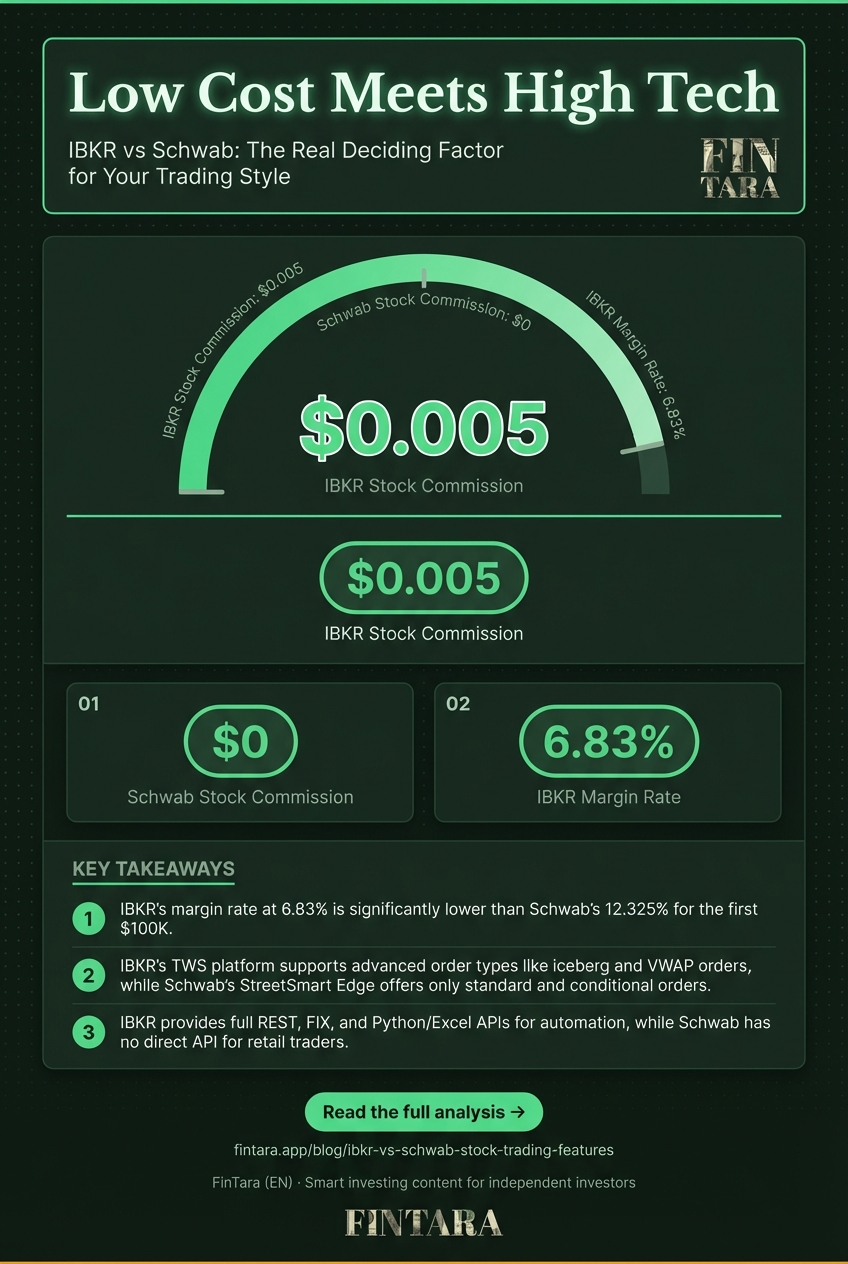
| Commission (US stocks) | Tiered: starts at $0.005/share | $0 online |
| Platform | TWS (desktop/web/mobile) | StreetSmart Edge (desktop), web, mobile |
| Advanced order types | Iceberg, VWAP, scale orders | Standard, conditional orders |
| API & automation | Full REST, FIX, Python/Excel | Limited, no direct API for retail |
| Margin rates (first $100K) | 6.83% | 12.325% |
| Research & education | Limited, self-directed | Extensive, integrated (Morningstar, Schwab Equity Ratings) |
| Customer support | Email/chat, slower for beginners | Phone, branch, strong retail focus |
| Best for | Active traders, algorithmic strategies | Long-term investors, buy-and-hold |
Where IBKR wins — institutional-grade tools and automation
 IBKR's TWS offers algorithmic order types, full API automation, and lower margin rates that give active traders a meaningful advantage. — Photo by RDNE Stock project on Pexels
IBKR’s TWS platform is built for traders who need depth. You get iceberg orders that hide your size, VWAP (volume-weighted average price) orders for executing large positions without moving the market, and scale orders that automate entry across price levels. Schwab’s StreetSmart Edge offers customizable charting and technical indicators, but it stops short of these algorithmic tools. For day traders or quant-style retail investors, TWS is the only platform that doesn’t feel like a compromise.
The API is the real differentiator. IBKR offers a full REST and FIX API, with libraries for Python, Excel, and more. You can connect your own screening logic, execute trades programmatically, and integrate with third-party analytics. Schwab provides a developer platform, but it’s geared toward institutional partners, not retail traders. If you want to automate a strategy—say, rebalancing a momentum screen weekly—IBKR is the practical choice. Schwab’s automation is limited to basic alerts and conditional orders.
IBKR’s margin rates compound this edge. At 6.83% for balances over $100,000, the cost of leverage is less than half of Schwab’s 12.325%. For a trader holding a $50,000 margin position for a year, that’s roughly $2,740 in interest at IBKR versus $6,163 at Schwab. The difference isn’t trivial—it’s the cost of two months’ worth of trading profits for many active strategies. Schwab’s higher rate reflects its retail focus; you’re paying for the ecosystem, not the cheapest cost of capital.
IBKR also wins on global access. You can trade stocks, options, futures, and currencies across 150+ markets from a single account. Schwab’s international offerings are more limited, and you’ll often need separate accounts for certain regions. If you’re building a globally diversified portfolio or hedging with forex, IBKR’s structure is more flexible. The trade-off is complexity: TWS has a steep learning curve, and you’ll spend time configuring settings rather than clicking through a guided interface.
Where Schwab wins — ease of use and integrated support
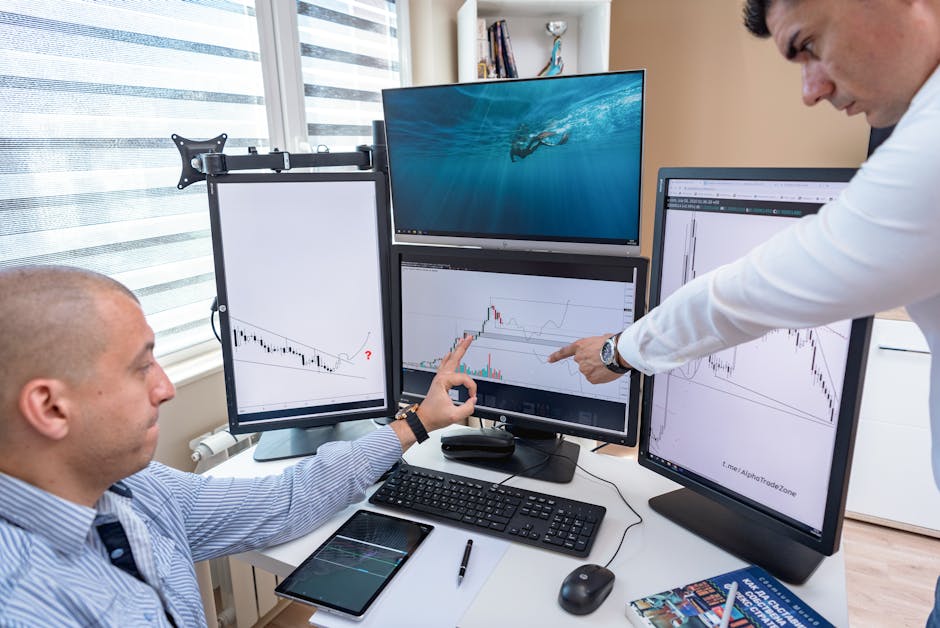 Schwab combines an intuitive trading interface with integrated research and responsive customer support for retail investors. — Photo by AlphaTradeZone on Pexels
Schwab’s platform is designed for the retail investor who wants to buy stocks, ETFs, or options without a manual. The web and mobile apps are intuitive, with clear navigation and straightforward order tickets. StreetSmart Edge on desktop adds customizable charting, but even here, the learning curve is gentler than TWS. You can place a trade in three clicks, set a price alert in one, and move on with your day. For investors who trade a few times a month, this efficiency matters more than advanced order types.
Research and education are where Schwab truly shines. You get Morningstar reports, Schwab Equity Ratings, and a library of articles and videos that explain concepts in plain language. IBKR’s research is more self-directed—you’ll need to source your own analysis from third-party tools like Finviz or Danelfin. Schwab’s integrated approach means you can research a stock, check its rating, and execute a trade without leaving the platform. For a long-term investor, this saves time and reduces decision fatigue.
Customer support is another Schwab advantage. You can call, visit a branch, or use live chat with agents who understand retail workflows. IBKR’s support is more email-driven, and responses can be slower for beginners. Schwab’s phone support often resolves issues in one call, which matters when you’re troubleshooting a trade or need help with a feature. This isn’t just convenience—it’s a safety net for investors who aren’t yet fluent in platform mechanics.
The cost structure favors buy-and-hold investors. Schwab’s $0 commission on online stock, ETF, and options trades means you can build a portfolio without worrying about per-trade fees. IBKR’s tiered pricing starts at $0.005 per share, which is low but not zero. For a $10,000 trade, that’s $5 at IBKR versus $0 at Schwab. While the difference seems small, it adds up for frequent traders—and Schwab’s zero-commission model is simpler to budget around. The trade-off is margin cost and advanced tools, but if you’re not using them, you’re not paying for them.
The hidden trade-off nobody mentions
 The section key argument clarifies the next practical decision. — Schwab's accessible margin rates and integrated banking services offset the complexity of IBKR's platform and asset-based pricing requirements. — Wikipedia contributors, via Wikimedia Commons
IBKR’s power comes with friction. The TWS platform is dense: menus within menus, settings that affect order execution, and a configuration process that can take weeks to master. Schwab’s simplicity, by contrast, is a feature in itself—you can be productive on day one. This isn’t just about learning curves; it’s about cognitive load. Every extra setting in IBKR is a decision point, and decision fatigue erodes performance over time. Schwab’s streamlined design reduces that burden, which can lead to better execution for retail investors who aren’t trading full-time.
There’s also a cost to IBKR’s low margin rates: they’re available to clients who meet certain asset thresholds or trading activity levels. Schwab’s margin is accessible to most retail accounts without hoops. If you’re starting out or have a smaller portfolio, you might not qualify for IBKR’s best rates immediately. Schwab’s higher rate is a premium for accessibility—pay more, but get in the door easier.
Finally, Schwab’s ecosystem includes banking features like checking accounts, debit cards, and physical branches. IBKR is a pure brokerage—no banking, no branches, no integrated financial services. For investors who want a one-stop shop, Schwab reduces the need to juggle multiple apps and accounts. IBKR’s purity is a strength for traders but a gap for those who want to manage cash, bills, and investments in one place. The hidden trade-off is context: IBKR optimizes for trading efficiency; Schwab optimizes for financial life management.
Choose IBKR if.
You trade frequently—weekly or more—and need advanced order types to execute large positions without market impact. You run automated strategies, even simple ones, and want API access to connect your tools. You use margin regularly and the interest cost difference materially affects your returns. You need global market access from a single account. You’re willing to invest time in learning a complex platform for long-term efficiency gains.
Choose Schwab if.
You trade monthly or less and prioritize ease of use over advanced features. You value integrated research, education, and customer support that guides you through decisions. You want a single platform for banking, investing, and cash management. You’re a long-term investor who buys and holds, and margin cost is a secondary concern. You prefer a polished, retail-focused experience over institutional-grade power.
Does IBKR or Schwab offer better tools for day trading?
IBKR’s TWS platform offers superior tools for day trading, including iceberg and VWAP orders. Schwab’s tools are adequate for casual day trading but lack the depth for high-frequency or large-size execution. If day trading is your primary activity, IBKR is the stronger choice.
Can I use automated trading strategies on IBKR compared to Schwab?
Yes, IBKR provides full API access for automated trading, with libraries for Python, Excel, and more. Schwab’s automation is limited to basic alerts and conditional orders. If you want to code and deploy strategies, IBKR is the only practical option.
What are the margin rates for IBKR vs Schwab?
IBKR’s margin rates start at 6.83% for balances over $100,000. Schwab’s rate is 12.325% for the same balance. The difference means IBKR costs less than half as much for leveraged positions, which compounds over time for active traders.
Which broker provides better customer support for beginners?
Schwab offers stronger support for beginners, with phone, branch, and live chat options. IBKR’s support is more email-driven and can be slower. If you’re new to trading and expect hand-holding, Schwab’s ecosystem is more accommodating.
Are there hidden costs when trading stocks on IBKR or Schwab?
IBKR’s tiered pricing means small per-share fees on US stocks, even at low volume. Schwab’s $0 commission eliminates this, but you’ll pay higher margin interest if you use leverage. The main hidden cost is your time: IBKR’s complexity requires more setup, while Schwab’s simplicity reduces time spent on platform mechanics.
Which platform is better for international trading?
IBKR supports trading across 150+ global markets from a single account. Schwab’s international offerings are more limited, and you may need separate accounts for certain regions. If you want a unified global portfolio, IBKR is the clear winner.
Do either platform offer fractional shares?
Schwab offers fractional shares for stocks and ETFs. IBKR does not currently support fractional share trading for US equities. If you want to invest small amounts in high-priced stocks, Schwab’s fractional share program is more flexible.
Which platform integrates better with third-party tools like Finviz or Danelfin?
IBKR’s API and export capabilities make it easier to connect with third-party screeners and analytics. Schwab’s ecosystem is more closed, with limited integration options. If you rely on external tools for research or execution, IBKR’s openness is an advantage.