
For most retail investors, Interactive Brokers wins on pure cost efficiency. Its tiered pricing structure drives stock commissions down to $0.005 per share, and margin rates sit significantly below Schwab’s standard charges. Charles Schwab, however, takes the lead on platform ease and integrated research—ideal for investors who prioritize simplicity over raw pricing power. Choose IBKR if you trade actively or use margin heavily; choose Schwab if you want a single login for banking, retirement, and trading with zero friction.
Quick comparison table
| Dimension | IBKR | Schwab |
|---|---|---|
| Stock commissions | Tiered: $0.005/share (min $1) | $0 for stocks/ETFs |
| Margin rate (first $100K) | ~5.33% (Pro) | ~12.325% (standard) |
| Platform depth | TWS: professional tools | StreetSmart Edge / thinkorswim |
| Fractional shares | Yes, for stocks/ETFs | Yes, for stocks/ETFs |
| Account minimum | $0 (IBKR Lite), $0 (Pro) | $0 |
| Tax reporting integration | Export to TurboTax, CSV | Direct TurboTax integration |
| Mobile app usability | Steep learning curve | Intuitive for beginners |
| Customer support | Chat/email; slower for retail | Phone/branch access; faster retail response |
Where IBKR wins — margin rates and execution control
 Interactive Brokers offers lower margin rates and more granular execution tools than Schwab, though the platform demands a steeper learning curve. — Photo by Hanna Pad on Pexels
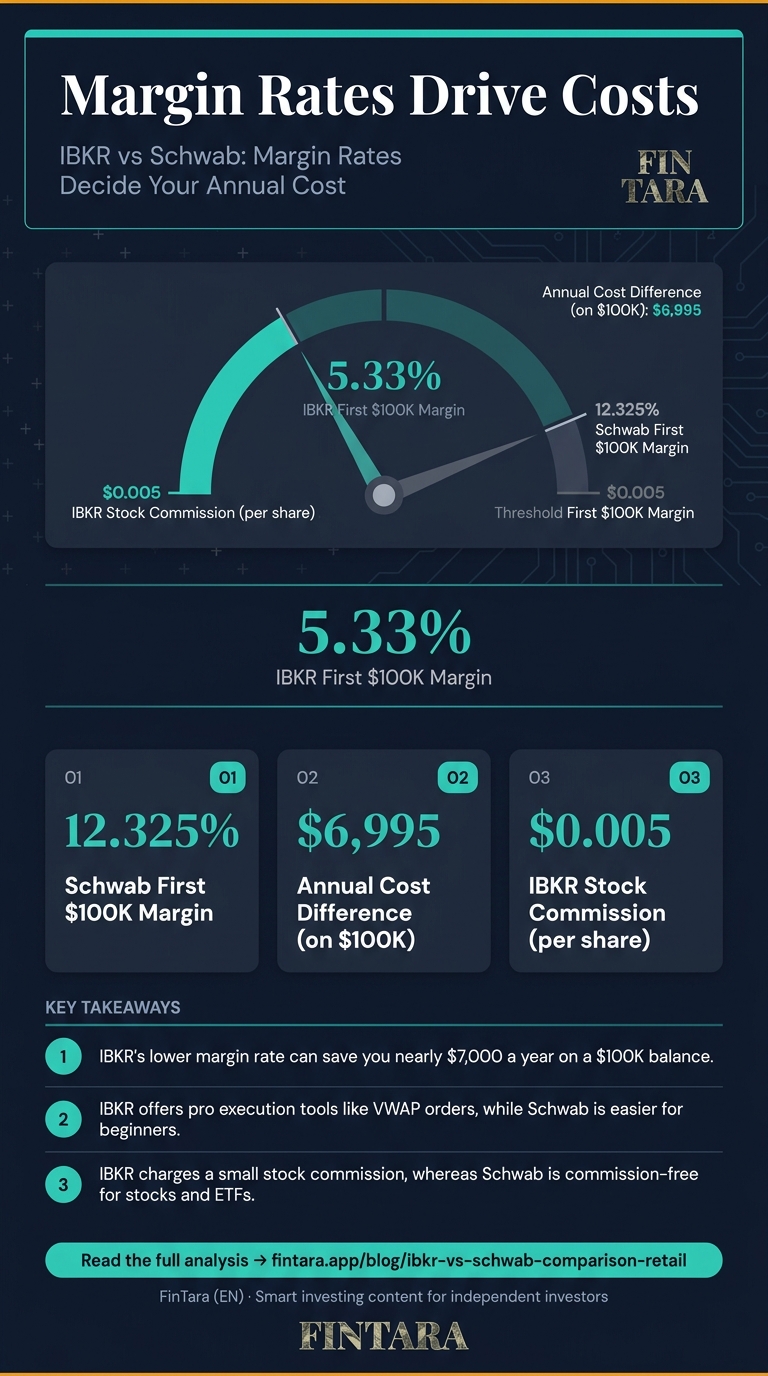
IBKR’s margin pricing is the clearest financial advantage. On the first $100K of margin balance, IBKR Pro charges approximately 5.33%. Schwab’s standard margin rate sits near 12.325%. That difference translates to thousands of dollars annually for anyone carrying a balance. The math is straightforward: 5.33% vs 12.325% on $100K equals roughly $6,995 in extra interest cost per year at Schwab. For investors who use margin even occasionally, that gap alone justifies the platform switch.
IBKR also delivers granular control over order execution. TWS offers algorithmic routing, volume-weighted average price (VWAP) orders, and detailed transaction cost analysis. For active traders, these tools translate into better fills and lower slippage. Schwab’s StreetSmart Edge provides solid order types but lacks the same depth of execution customization. The trade-off is complexity: IBKR’s interface is dense, and the learning curve is real. You must invest time to master it.
Tax reporting is another IBKR strength. The platform exports trade history in formats compatible with TurboTax and other software, and its tax-lot accounting is precise. Schwab integrates directly with TurboTax, which reduces manual entry for most users. If you file taxes yourself, IBKR’s export flexibility matters. If you use a CPA, Schwab’s direct integration may save time. Neither platform is perfect; both require review before filing.
Where Schwab wins — platform ease and integrated ecosystem
 Schwab delivers a streamlined, all-in-one platform experience with superior customer support and integrated research, though at higher costs. — Photo by AlphaTradeZone on Pexels
Schwab’s advantage is frictionless usability. The mobile app is intuitive, and account setup takes minutes. After three months using Schwab for a taxable account, the experience feels streamlined: one login for banking, retirement, and trading. IBKR requires separate logins for TWS and the client portal, and the mobile app is functional but not beginner-friendly. For investors who value simplicity over advanced tools, Schwab reduces cognitive load.
Schwab also leads on customer support quality for retail users. Phone support is accessible, and branch access provides in-person help. IBKR’s support is primarily chat and email, with slower response times for retail accounts. This difference matters during market volatility or when account issues arise. If you need human reassurance during a crash, Schwab’s phone support is a tangible advantage.
Research resources differ as well. Schwab offers integrated research from Morningstar, Reuters, and its own analysts, all within the platform. IBKR provides third-party research but requires more navigation to access it. For investors who rely on curated analysis, Schwab’s presentation is cleaner. The trade-off is cost: you’re paying for that convenience via higher margin rates and potential order routing differences.
The hidden trade-off nobody mentions
 The section key argument clarifies the next practical decision. — IBKR's tiered pricing often costs more than Schwab's zero-commission model for casual investors who trade small or infrequent orders. — Wikipedia contributors, via Wikimedia Commons
IBKR’s tiered pricing structure can backfire for casual investors. If you trade infrequently, the per-share fee model means you might pay more than Schwab’s $0 commissions for small orders. The minimum $1 per trade on tiered pricing means a 100-share order costs $1 in commission—Schwab would be $0. For buy-and-hold investors who trade quarterly, Schwab’s zero-commission model is cheaper overall.
Schwab’s margin rates, while high, are transparent. IBKR’s rate structure is complex, with tiered pricing based on monthly volume and account size. For a new retail investor, deciphering which tier applies can be confusing. Schwab’s single margin rate is easier to understand, even if it’s more expensive. The hidden trade-off is clarity vs. cost: IBKR saves money if you know how to navigate its pricing; Schwab saves time if you prefer simplicity.
Tax reporting is another hidden dimension. IBKR’s detailed exports are powerful but require more effort to reconcile. Schwab’s TurboTax integration automates much of this, but you lose some granularity. If you trade complex strategies (options, futures), IBKR’s tax-lot precision matters. If you stick to stocks and ETFs, Schwab’s integration is sufficient. The choice depends on your portfolio complexity.
Choose IBKR if. / Choose Schwab if.
Choose IBKR if you trade frequently, use margin regularly, or need advanced execution tools. The cost savings on commissions and margin rates compound quickly for active investors. If you’re comfortable with a professional-grade platform and willing to learn TWS, IBKR delivers superior control and pricing. For investors building a career in trading, IBKR is the foundational platform.
Choose Schwab if you want an all-in-one financial ecosystem with zero-commission trading and strong customer support. The platform is ideal for beginners, retirement savers, and investors who prioritize ease over cost optimization. If you hold long-term positions and rarely use margin, Schwab’s higher rates won’t materially impact your returns. The integrated research and banking features add convenience that IBKR doesn’t match.
For hybrid investors—active traders who also hold long-term positions—consider using both. Schwab for retirement accounts and core holdings; IBKR for tactical trading and margin strategies. This approach captures Schwab’s ease and IBKR’s cost efficiency. The downside is managing two platforms, but the diversification of tools can be worth it.
FAQ
Which has lower fees: IBKR or Schwab for retail traders?
IBKR has lower fees for active traders due to tiered commissions and margin rates. Schwab offers $0 stock/ETF commissions but higher margin costs. Choose based on your trading frequency.
What trading platforms does Interactive Brokers offer for beginners?
IBKR offers IBKR Lite (simpler interface) and IBKR Pro with TWS. Lite is more beginner-friendly but lacks some advanced tools. TWS is professional-grade with a steeper learning curve.
How does Schwab’s research tools compare to IBKR’s?
Schwab integrates Morningstar, Reuters, and proprietary research in a clean interface. IBKR provides third-party research but requires more navigation. Schwab is better for curated analysis.
Can I use thinkorswim with a Schwab account?
Yes. Schwab acquired TD Ameritrade in 2020, integrating thinkorswim into its platform. You can use thinkorswim for advanced charting and options analysis.
Does IBKR support fractional shares for retail investors?
Yes. IBKR supports fractional shares for stocks and ETFs. Schwab also offers fractional shares, known as “Stock Slices,” for stocks under $1,000.
What are the account minimums for IBKR and Schwab?
Both platforms have $0 account minimums. IBKR Lite and Pro accounts can be opened with no initial deposit. Schwab requires no minimum to open a brokerage account.
How do customer support response times compare?
Schwab offers phone and branch support with faster retail response. IBKR relies on chat and email, with slower times for retail accounts. Choose Schwab if you value human support.
Which platform is better for tax reporting?
IBKR exports detailed trade history for tax software, offering granular control. Schwab integrates directly with TurboTax for automated filing. Choose based on your tax complexity.