
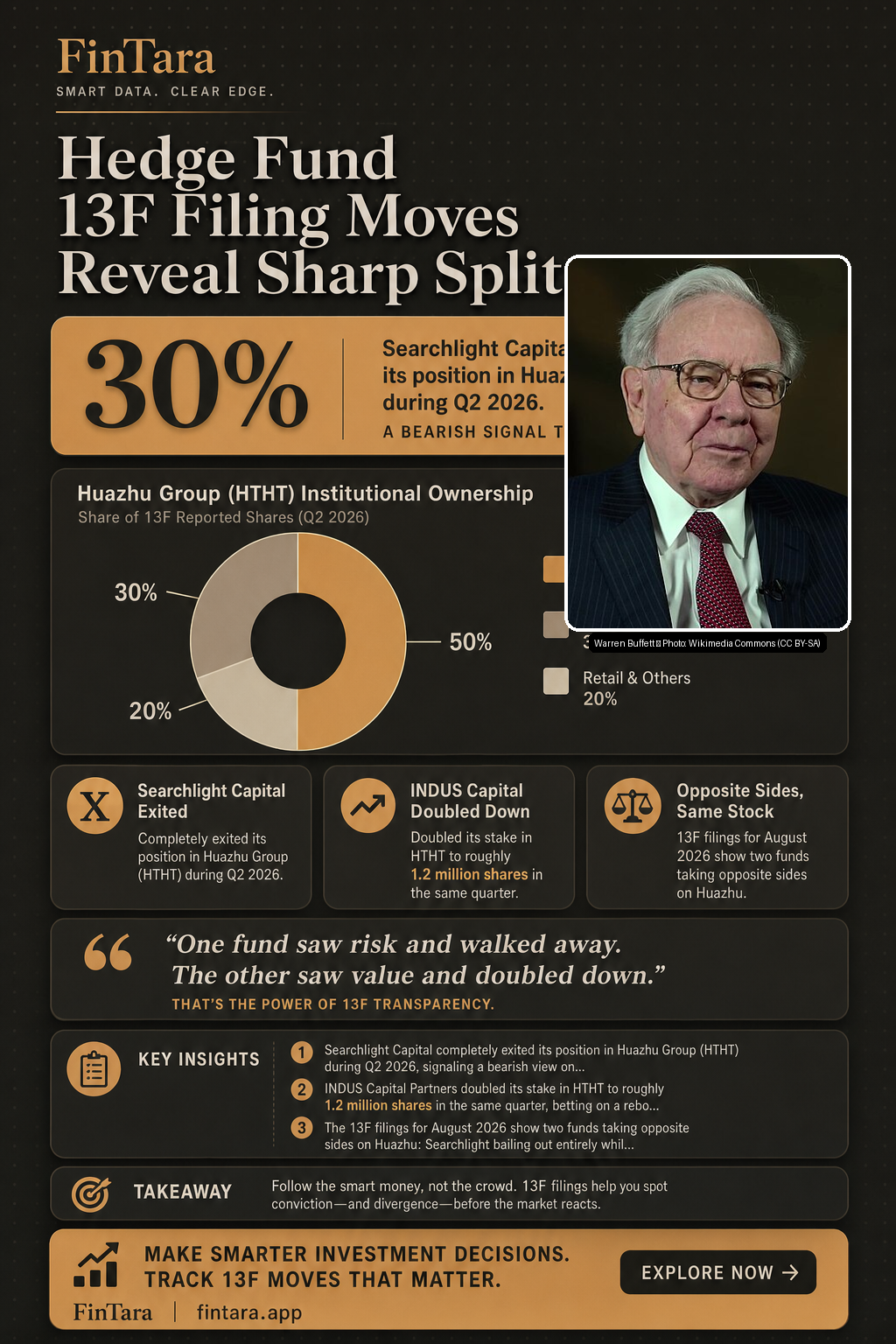
The latest 13F filings reveal hedge funds adjusting positions in hotel and homebuilder stocks. This list covers seven notable moves from the August 2026 filing season, including Searchlight's exit and INDUS doubling its HTHT stake. Use these to gauge institutional sentiment.
1. Searchlight Exits HTHT Entirely
Searchlight Capital fully removed Huazhu Group (HTHT) from its 13F filing. The exit came in the quarter ended June 30, 2026. HTHT operates hotels under brands like HanTing and Ji Hotel in China.
Searchlight's exit follows a period of weak Chinese travel demand. A full exit signals a bearish view on China's hospitality recovery.
2. INDUS Doubles Its HTHT Stake
 A hedge fund's doubling down signals confidence in the hotel chain's discounted valuation. — Photo by Jakub Zerdzicki on Pexels
INDUS Capital Partners increased its HTHT position by 100% in the same quarter. The doubling brought INDUS's stake to roughly 1.2 million shares. INDUS likely sees value in HTHT's discounted valuation after a 30% drop.
Contrarian buying contrasts with Searchlight's exit. The move shows hedge funds disagree on China's hotel recovery.
3. Warren Buffett Buys D.R. Horton as New Position

Berkshire Hathaway filed a new 13F position in D.R. Horton (DHI) on August 14, 2026. D.R. Horton is the largest US homebuilder by volume. The new purchase came despite high US mortgage rates.
Buffett's bet suggests confidence in housing supply shortages. The SEC filing shows DHI as the only new position added.
4. Buffett Triples Down on Alphabet
Berkshire increased Alphabet (GOOGL) by $12.6 billion in reported value, the largest increase across all holdings. The increase added 3.48 percentage points to portfolio weight. Alphabet now represents 9.4% of Berkshire's disclosed equity portfolio.
The bet follows Alphabet's strong cloud and advertising revenue growth. This marks a rare big tech addition for Buffett's value-oriented style.
5. Buffett Cuts Occidental Petroleum, Chevron, and Kroger
Berkshire reduced Occidental Petroleum by $4.35 billion, the largest trim in the quarter. Chevron and Kroger were also among the largest reductions. Total positions in the latest filing dropped to 10, down from 11.
The oil cuts signal caution on crude price volatility. Kroger's reduction follows its failed merger with Albertsons.
6. Constellation Brands Fully Exits Buffett's Portfolio
Berkshire sold all remaining shares of Constellation Brands (STZ). The exit came after STZ represented 0.04% of the prior portfolio. Constellation makes Modelo beer and Svedka vodka.
The sale reflects weak consumer demand for beer and spirits. It was the only full exit in Berkshire's latest 13F.
7. Apple and AMEX Still Dominate Buffett's Top Holdings
Apple remains Berkshire's largest holding at 22.0% of the portfolio. American Express holds second place at 17.1%. Coca-Cola (10.9%), Alphabet (9.4%), and Bank of America (9.2%) round out the top five.
Berkshire added to Apple and American Express in the quarter. The concentration shows Buffett's defensive consumer and financial tilt.
How to Find These Moves Yourself
Hedge funds must file 13F forms within 45 days after each quarter ends. The SEC EDGAR database offers free access to all 13F filings. HedgeFollow tracks over 10,000 hedge funds and 100,000+ insiders via its platform.
Dedicated trackers for hedge fund buys, insider trading, and congressional trades are available. Search by fund name or ticker to see position changes quarter-over-quarter.
What the Divergence Means for HTHT
Searchlight's exit and INDUS's doubling show a split in hedge fund sentiment on HTHT. China's hotel occupancy rates recovered only 80% of pre-pandemic levels in 2025. HTHT trades at 1.2x book value, below its five-year average of 2.0x.
The divergent moves create a potential contrarian signal for individual investors. Watch for further 13F filings to see if one side is proven right.
Key Data Points From the Latest 13F Season
Berkshire's filing on August 14, 2026 showed 10 total positions. Only one new position (D.R. Horton) and one full exit (Constellation) occurred. The largest increases went to Alphabet, Apple, and American Express.
The biggest reduction hit Occidental Petroleum at $4.35 billion. Aggregate 13F data from HedgeFollow shows continued institutional rotation into housing.
FAQ
What does it mean when a hedge fund like INDUS doubles its stake in HTHT?
A doubling signals strong conviction. INDUS sees HTHT as undervalued relative to its recovery potential. It also indicates the fund expects higher hotel occupancy or cost improvements. The increase is disclosed in a 13F filing, which lists long positions but not short positions or derivatives.
Why would Searchlight exit a hedge fund position in HTHT?
Searchlight likely lost confidence in China's hospitality recovery. Weak consumer spending and slower-than-expected travel have hurt hotel operators. A full exit removes risk but also forfeits upside. Institutional exits often precede price declines, but that outcome is not guaranteed.
How often are 13F filings updated and when are they due?
Hedge funds must file 13F forms within 45 days after each quarter ends. That means files are due by mid-February, mid-May, mid-August, and mid-November. Filings are public via the SEC EDGAR system. They reflect positions as of the last day of the quarter. Many funds file on the deadline date.
What can 13F filings tell us about hedge fund strategies?
13Fs reveal only long positions in US-listed equities over $1 million in value. They do not show short positions, derivatives, or cash. Still, quarter-over-quarter changes show which stocks funds are buying or selling. Comparing multiple funds helps identify consensus trades within sectors like hotels or homebuilders.
Are there tax implications when a hedge fund exits a position?
For the fund itself, a realized gain or loss affects its taxable income. Individual investors do not bear direct tax consequences from a hedge fund's trade. However, if you mimic the move, selling shares could trigger capital gain taxes. Always consult a tax professional for your specific situation.