
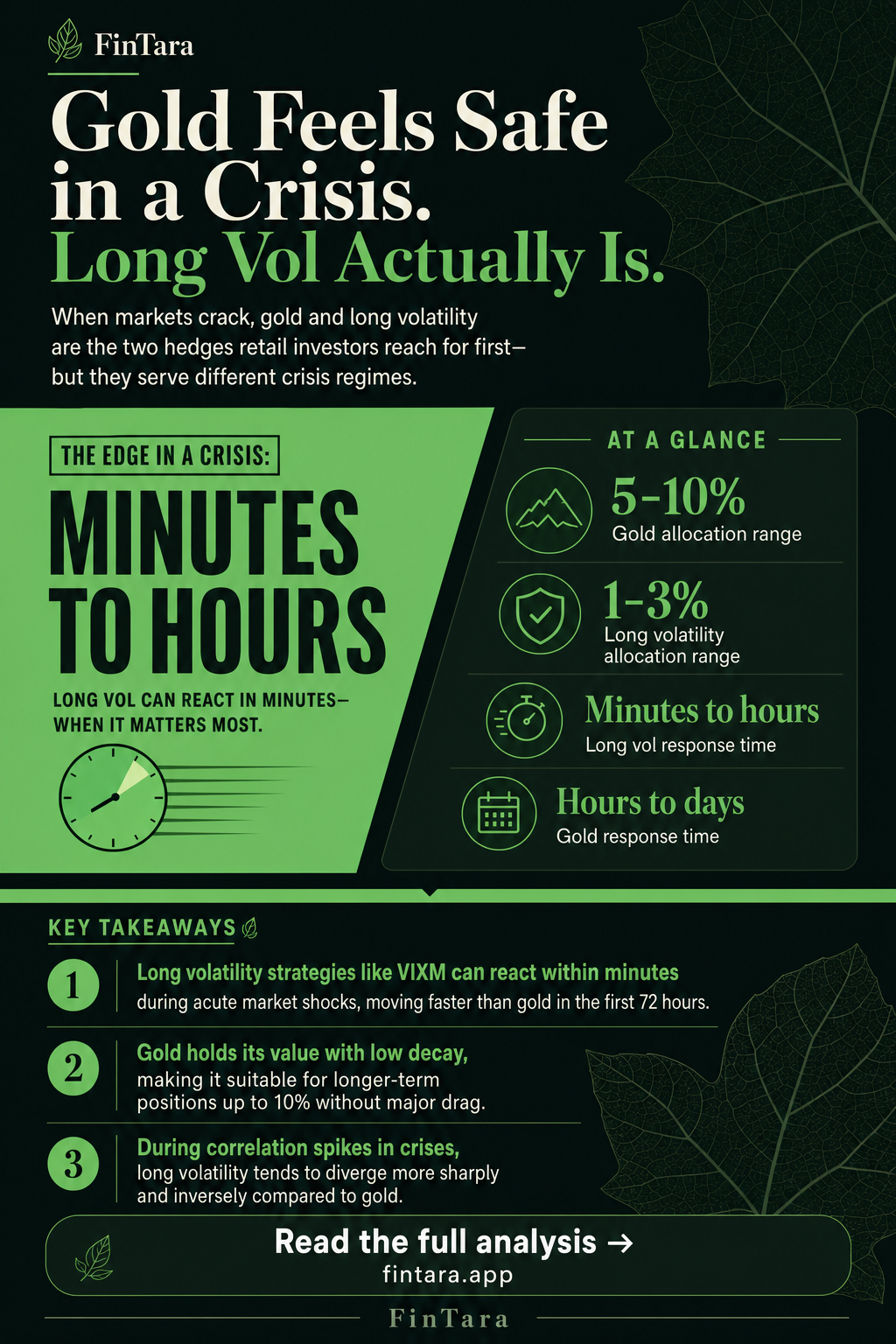
When markets crack, gold and long volatility positions are the two hedges retail investors reach for first. Gold wins for most people — it's liquid, portable across accounts, and doesn't decay. But in the first 72 hours of an acute shock, when correlations spike and everything reprices simultaneously, long volatility strategies move faster and more decisively. The question isn't which one is better. It's which one matches the specific crisis regime you're preparing for.
Quick Comparison: Gold vs. Long Volatility in a Correlation Spike
| Dimension | Gold (e.g., GLD, IAU) | Long Volatility (e.g., VIXM, tail-risk funds) |
|---|---|---|
| Crisis response speed | Hours to days | Minutes to hours |
| Decay cost in calm markets | Low (storage/management fee) | High (negative roll, theta) |
| Liquidity during stress | Deep — trades through most crises | Can widen significantly |
| Correlation with equities (normal) | Low to mildly negative | Strongly negative |
| Correlation with equities (crisis) | Temporarily jumps, then diverges | Spikes inverse hard |
| Accessible via ETF | Yes — GLD, IAU, GLDM | Yes — VIXM, VOOL, tail funds |
| Suitable for long-term hold | Yes | No |
| Portfolio allocation range | 5–10% without major drag | 1–3% max before drag compounds |
| Works in liquidity crises | Partially — can be sold to raise cash | Partially — spreads widen |
| Behavioral durability | High — easy to hold | Low — painful to hold through calm |
Where Gold Wins — Staying Power Through a Multi-Month Dislocation
 Gold's lack of counterparty risk lets it recover faster than equities and hold gains through extended periods of market stress. — Photo by energepic.com on Pexels
Gold's edge isn't in the first few hours. It's in what happens after the initial shock.
When correlations jump, almost every asset gets sold. Gold often takes an early hit too — investors selling everything to raise cash. But it recovers faster than equities and tends to hold its gains through the subsequent regime of policy uncertainty and currency debasement. That's the pattern from 2008, 2020, and the 2022 geopolitical shock in Q1. market correlation shifts during crises
The structural reason: gold has no counterparty. It doesn't depend on corporate earnings, central bank credibility, or a functioning repo market. When those mechanisms break down, gold's independence from the financial system becomes the feature, not the footnote.
For retail investors, the cost structure also matters. GLD and IAU trade during market hours with tight spreads under normal conditions. In a multi-week dislocated environment — not a flash crash but a sustained crisis like early 2020 — gold remains accessible when some other hedges don't.
The trade-off is real though. Gold doesn't pay you to wait. In a low-volatility bull market, a 7% gold allocation drags on performance. The holding cost isn't severe, but it's real over multi-year periods. Investors who've owned gold through 2012–2018 know exactly how long that wait can feel.
Where Long Volatility Wins — The First 72 Hours of a Correlation Spike
 Long volatility positions deliver immediate, front-loaded gains during the first 72 hours of an acute correlation shock. — Photo by RDNE Stock project on Pexels
Long volatility positions do one thing better than any other hedge: they move immediately when markets dislocate.
VIX spikes are front-loaded. When correlations jump in an acute shock — a bank failure, a geopolitical escalation, a surprise inflation print that reprices everything at once — implied volatility explodes in the first trading session. A position in VIXM or a tail-risk fund captures that move directly. Gold might be flat or down on day one. Long volatility is up.
That asymmetry is the entire case for long vol as a crisis hedge. You're not buying an asset that will eventually do well. You're buying a direct short on complacency.
The problem is decay. VIX futures are in contango most of the time. That means rolling from one month's contract to the next costs money — and it adds up. In a quiet market, long volatility positions bleed steadily. This isn't a rounding error. It's a structural drag that makes long vol unsuitable as a core holding.
The practical implication: sizing matters more than instrument selection. A 1–2% allocation to a tail-risk vehicle absorbs the decay cost while still providing meaningful protection when the correlation spike arrives. A 5% allocation looks attractive in a stress scenario and will quietly destroy returns across the flat years in between.
The Hidden Trade-Off Nobody Mentions: Correlation Spikes Happen in Phases
 During a correlation spike, long volatility captures the initial shock phase while gold dominates the extended regime that follows. — Photo by Pavel Danilyuk on Pexels
The standard comparison between gold and long volatility misses the phase structure of a real correlation spike.
Phase one is the shock itself — the announcement, the failure, the flash. Volatility explodes. Correlations jump toward 1.0 across equities, credit, and even commodities in some scenarios. This is when long volatility wins and gold can lag.
Phase two is the repricing — hours to days after the shock, as investors assess damage and central banks signal response. Correlations remain elevated. Gold and volatility both perform, but the volatility spike often moderates faster than expected.
Phase three is the sustained regime — weeks to months of elevated uncertainty, policy intervention, and gradual mean reversion. This is gold's environment. Long vol positions that weren't closed in phase one are now paying the roll cost without capturing new spikes.
Most retail investors hold a hedge through all three phases. That's where the comparison breaks down. The hedge that performs best in phase one is often the worst one to hold through phase three. The hedge that survives phase three often missed the initial spike entirely.
Sizing each appropriately for its phase — and knowing when to exit — is where the real edge lives. market correlation shifts during crises
Choose Gold If. / Choose Long Volatility If.
Choose gold if:
- Your horizon for the crisis scenario is weeks to months, not days
- You want a hedge that doesn't punish you for being early
- You're concerned about currency debasement or policy uncertainty alongside equity stress
- You can hold through periods when gold underperforms and does nothing
- You want something that survives a liquidity crunch without widening spreads destroying the position
Choose long volatility if:
- You're hedging a specific short-term risk window — earnings, a Fed meeting, a geopolitical event with a known date
- Your portfolio is concentrated in equities and you need a direct inverse position, not a soft hedge
- You understand the roll cost and have sized accordingly — meaning small, not core
- You're prepared to manage the position actively and exit when the spike materializes
- You're not planning to hold it through a prolonged calm market
The case for holding both simultaneously:
It's not a contradiction. A 5–7% gold position plus a 1–2% long volatility allocation gives you coverage across both phases. Gold costs you in bull markets. Long vol costs you in calm markets. Together, the drag is meaningful but not catastrophic — and the combined hedge handles a wider range of crisis scenarios than either alone.
The mistake most retail investors make is treating these as either/or. The real decision is about sizing each appropriately, not choosing one and abandoning the other.
FAQ
Does gold actually hold up on the first day of a market crash?
Not always. In acute liquidity crises — March 2020 being the clearest recent example — gold sold off early as investors raised cash by selling whatever was liquid. The initial drop was short-lived, but day-one performance has been negative in several historical stress events. Long volatility positions tend to outperform gold in that first session specifically.
What's the cheapest way to hold long volatility without getting crushed by decay?
PPUT — an ETF that holds S&P 500 puts — has a lower roll cost than VIX-based products but captures tail risk more precisely. Allocating 1–2% of the portfolio reduces the annual drag to a level comparable to gold's storage cost. Holding more than 3% makes the decay a portfolio problem, not just a hedge cost.
If correlations spike to 1.0 in a crisis, doesn't gold get dragged down with everything else?
Briefly, yes. The initial sell-everything phase affects gold because it's liquid and widely held. But gold's correlation with equities over multi-week horizons is structurally lower than most assets — including bonds in a rising-rate crisis environment (as Q1 2022 demonstrated). The spike in correlation is real but short-lived for gold specifically.
Can a retail investor use GLD for short-term crisis hedging and IAU for long-term holding?
The difference matters most at larger positions. IAU charges a lower management fee than GLD. But GLD has deeper volume and tighter spreads under stress. For a short-term crisis hedge where you might need to exit quickly during dislocated markets, GLD's liquidity advantage outweighs the small fee difference. For a long-term strategic allocation, IAU's fee structure compounds favorably.
Do bond-equity correlations flipping positive in 2022 change which hedge is better?
Yes — significantly. The traditional 60/40 assumption relied on negative bond-equity correlation as a built-in hedge. When both fell together in 2022, it removed bonds from the crisis hedge toolkit for that specific regime. It reinforced the case for gold and long volatility as genuine diversifiers rather than bond exposure dressed differently. For Q2 2026, with rate uncertainty still elevated, that lesson still applies.
How much of a portfolio should be in crisis hedges altogether?
There's no fixed answer, but the constraint is drag cost. A combined 7–9% hedge allocation — say 6% gold and 2% long volatility — creates a meaningful buffer without compounding into a significant return headwind over a full market cycle. Going above 10% in total hedge exposure makes outperforming a simple index fund in normal years structurally difficult.
Crisis hedges fail most investors not because the hedges don't work, but because they're sized for the scenario that never arrives while the regime that does arrive was different.