
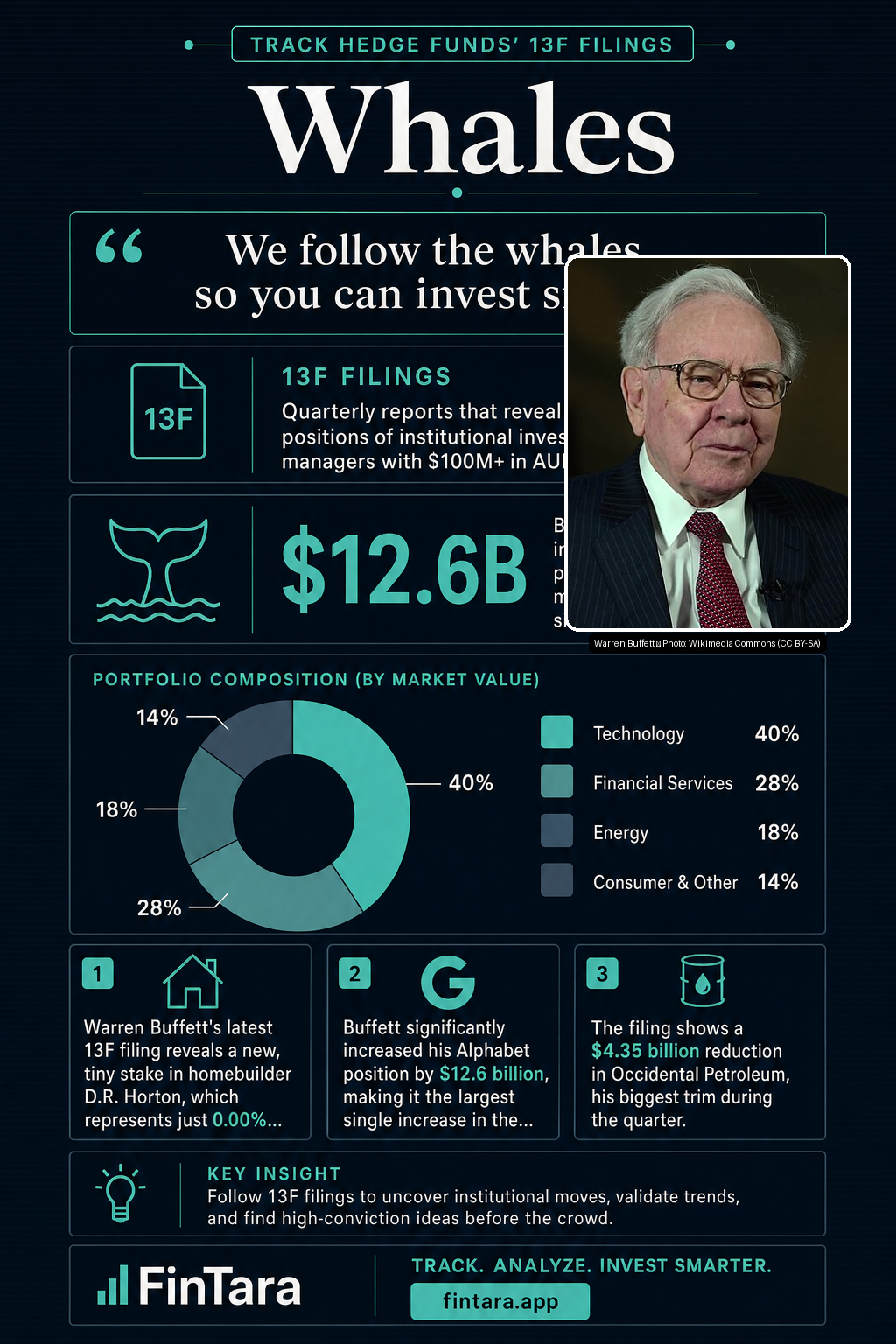
Warren Buffett's 13F filing on August 14, 2026, added D R Horton and raised Alphabet by $12.6 billion, while trimming Occidental and exiting Constellation Brands. Investors can track these moves through SEC filings and platforms like WhaleWisdom and Unusual Whales, which aggregate the data for analysis.
The August 2026 13F Filing: A New Homebuilder Bet and a Big Alphabet Raise
Warren Buffett's 13F filed on 2026-08-14 reveals a portfolio of 10 positions. The largest new position was D R Horton, a homebuilder, but it represents just 0.00% of the portfolio.
Alphabet received the largest increase, adding $12,557,527,438 in reported value, which is 3.48 points of portfolio weight. Apple remains the top holding at 22.0% of the portfolio, followed by American Express at 17.1%.
The filing also shows exits, including Constellation Brands, which was fully removed after being only 0.04% of the prior portfolio.
The Paper Trail: SEC Filings and Disclosure Deadlines
 Large investors must file quarterly 13F reports and 13D/G disclosures within strict deadlines, with 13F showing only long positions. — Photo by Gustavo Fring on Pexels
Any manager with at least $100 million in qualifying investments must file a 13F quarterly with the SEC.
13F filings are due no more than 45 days after each quarter ends, according to WhaleWisdom. Owners of more than 5% of a public security must file 13D/G within 10 business days of a triggering event, per WhaleWisdom.
The 13F lists long equity positions, but not short positions or cash, as clarified by WhaleWisdom. Buffett's filing shows the largest trim was in Occidental Petroleum, reduced by $4,352,987,711, which is 2.25 points of portfolio weight.
Pattern Recognition: How Buffett's Moves Reflect a Broader Strategy
 Recent portfolio adjustments reveal a strategic pivot toward technology while reducing exposure to energy and consumer staples. — Photo by RDNE Stock project on Pexels
Buffett reduced Chevron by an unspecified amount and Kroger by an unspecified amount, according to the SEC filing. Occidental's reduction of $4.35 billion was the largest trim, signaling a shift away from energy exposure.
The Alphabet increase of $12.6 billion is the largest single addition, indicating a bet on tech and advertising. Apple and American Express remain top holdings, showing a focus on consumer and financial sectors. The exit from Constellation Brands, a beverage company, suggests a move away from consumer staples.
Who Benefits and Who Loses from Following 13F Filings
Individual investors benefit by seeing what Buffett and other whales are buying, per WhaleWisdom. Platforms like Unusual Whales provide options flow and dark pool data for deeper insights.
Retail investors who replicate 13F moves may lose because filings are delayed by up to 45 days, as per SEC. Managers who sell before a filing is public may benefit from the lag, while followers miss the move.
The 13F does not show transaction dates, so investors cannot know if a position was bought early or late in the quarter.
What Changes Next: Upcoming Filings and Tools to Watch
The next 13F wave after the August 2026 filing will come within 45 days of the quarter end, per SEC.
Watch for additional 13D/G filings from owners of more than 5% of a security, as they are due within 10 days of trades, per WhaleWisdom. WhaleWisdom offers a 13F Fund Performance Search and a 13F Stock Screener for tracking.
Unusual Whales provides options flow, dark pool data, and an API for programmatic access. Investors should compare 13F filings across quarters to see if a manager is building or trimming a position.
Practical Steps to Track Hedge Funds Using 13F Data
Start by accessing official SEC EDGAR to find raw 13F filings, as shown in the Buffett filing. Use WhaleWisdom to screen for top holdings and compare fund performance across quarters.
Set alerts on Unusual Whales for options flow and dark pool data that complement 13F filings. Track 13D/G filings to see when an investor crosses the 5% ownership threshold, as explained by WhaleWisdom.
Analyze the dollar value changes, such as Buffett's Alphabet raise of $12.6 billion, to gauge conviction levels.
FAQ
What is a 13F filing and who has to file it?
A 13F filing is a quarterly report that institutional investment managers with at least $100 million in qualifying assets must submit to the SEC. It lists all long equity positions, including stock names, share counts, and values. The filing is public, providing transparency into the holdings of large investors.
How often are 13F filings released?
13F filings are required every quarter, and managers must submit them within 45 days after the end of each quarter. This means filings are typically released in February, May, August, and November. The exact date varies by when the quarter ends, but the 45-day deadline is fixed by SEC rules.
What is the difference between 13F and 13D/G filings?
A 13F filing reports all long equity positions of a large manager, while a 13D/G filing is required when an investor owns more than 5% of a public company and changes that position. 13D/G filings are due within 10 business days of a triggering event, offering more timely information than 13F filings.
How can I replicate the portfolio of successful hedge funds?
Review their latest 13F filing on SEC EDGAR or through platforms like WhaleWisdom. Focus on new positions and large increases, such as Buffett's $12.6 billion Alphabet raise. Remember that filings are up to 45 days old, so do your own research on current prices and fundamentals before buying.
Are 13F filings delayed, and how does that affect tracking?
Yes, 13F filings are delayed by up to 45 days, meaning the reported holdings are not current. This gives large investors time to trade without immediate transparency. Tracking still works for identifying long-term trends, but you cannot know the exact timing of any trade based on a 13F alone.
What tools are best for tracking hedge fund 13F data?
WhaleWisdom offers a 13F Fund Performance Search and a 13F Stock Screener for deep analysis. Unusual Whales provides options flow, dark pool data, and an API for advanced users. SEC EDGAR is the free, official source, but these platforms add convenience and comparison features.