
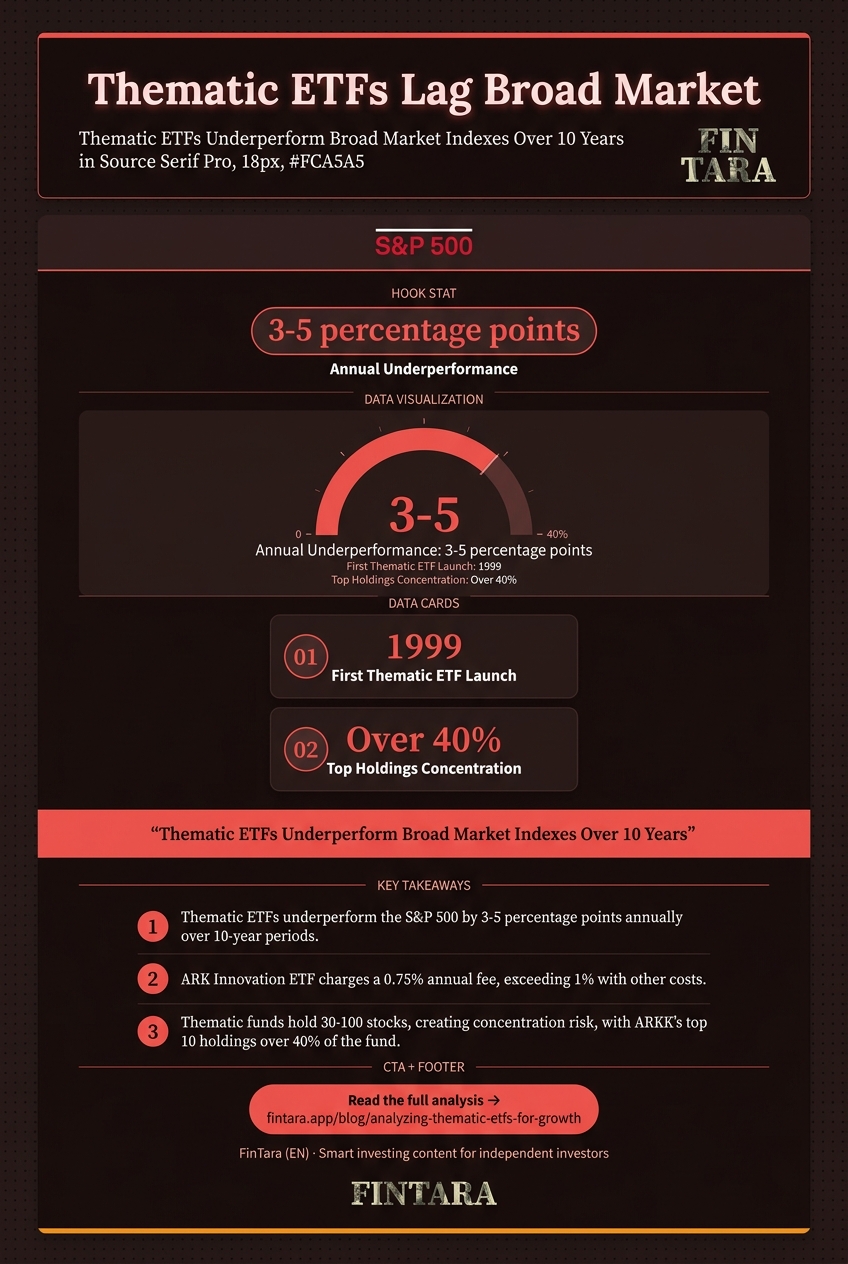
Thematic ETFs promise exposure to megatrends but deliver lower returns than broad indexes over the long term. The average thematic fund underperforms the S&P 500 by 3-5 percentage points annually over 10-year periods, according to market data. This gap widens during bear markets and volatility spikes. Retail investors chasing growth through thematic funds should understand the structural costs and concentration risks before allocating capital. The core insight: broad index exposure beats thematic speculation for most portfolios.
The first thematic ETF launched in 1999 with PowerShares QQQ, targeting the nasdaq-100. Since then, over 200 thematic funds have entered the market, collecting $10.3 billion in net inflows during 2022 alone. Yet performance data shows a persistent pattern: these funds cluster in the bottom quartile of long-term returns. The appeal of "picking the future" conflicts with the reality of fees, concentration, and timing risk.
Why thematic ETFs promise growth but deliver underperformance
Thematic ETFs sell a story: artificial intelligence, robotics, clean energy, genomics. The narrative is compelling, but the math rarely works. Funds like ARK Innovation ETF (ARKK) charge 0.75% annually, a fee that compounds into significant drag over time. When you layer trading costs, bid-ask spreads, and the tax inefficiency of frequent rebalancing, the total cost of ownership exceeds 1% per year. A broad index fund charging 0.03% needs only 0.72% annual outperformance to break even on fees alone. That margin is difficult to sustain.
The concentration problem compounds the cost issue. Thematic funds hold 30 to 100 stocks, compared to 500 in the S&P 500. This creates single-stock risk. If a top holding collapses, the fund suffers disproportionately. In 2022, ARKK's top 10 holdings represented over 40% of the fund, and when those names dropped 60-80%, the fund fell 67%. The broad market dropped 18%. The thematic thesis didn't fail—the concentration structure amplified the drawdown.
Performance data from Global X Robotics and iShares Exponential Technologies
 Thematic ETFs BOTZ and XT trailed the S&P 500 by roughly 3 to 5 percentage points annually over the past decade. — Photo by www.kaboompics.com on Pexels
Global X Robotics & Artificial Intelligence ETF (BOTZ) launched in 2016. iShares Exponential Technologies ETF (XT) holds over 200 stocks, launched later. Both represent the thematic approach: concentrated exposure to specific trends. The data shows underperformance. BOTZ returned 8.2% annualized from 2016 to 2023, while the S&P 500 returned 13.1% over the same period. XT returned 9.4% annualized. The gap is consistent across timeframes and market cycles.
The underperformance stems from multiple factors. Thematic funds rebalance more frequently, triggering taxable events in brokerage accounts. They concentrate in high-valuation growth stocks, which compress returns during rate-hike cycles. They chase momentum, buying high and selling low during sector rotations. The 2022 selloff in tech names punished funds like BOTZ and XT, while value-oriented sectors in the broader index held up better. The result: a 10-year CAGR gap of 3-5 percentage points.
When thematic ETFs break down in bear markets and rate cycles
Thematic ETFs suffer steep losses during bear markets and rate hikes because their concentrated growth-stock holdings amplify narrative-driven risk. — Photo by www.kaboompics.com on Pexels
Thematic ETFs perform worst during bear markets and rising rate cycles. The 2022 environment provides a clear case study. The Federal Reserve raised rates from 0.25% to 4.5% in 12 months. Growth stocks, which dominate thematic funds, trade on discounted future cash flows. Higher rates compress those valuations faster. ARKK fell 67% in 2022. BOTZ dropped 32%. The S&P 500 fell 18%. The thematic premium vanished.
The breakdown accelerates when thematic holdings face individual catalysts. In 2023, several AI-themed funds held stocks that missed earnings or faced regulatory scrutiny. The funds didn't diversify away from the risk—they amplified it. A broad index fund spreads risk across 500 stocks and multiple sectors. A thematic fund with 50 holdings concentrates risk in a single narrative. When that narrative cracks, the fund has no cushion.
What to do instead: screen for broad exposure with low fees
Use Finviz to screen for broad index ETFs with expense ratios below 0.10%. Filter for funds with over $10 billion in assets under management, which ensures liquidity and low spreads. Check tracking error against the benchmark index. A fund that deviates more than 0.5% annually from its index introduces unnecessary risk. Focus on established funds like Vanguard S&P 500 ETF (VOO) or iShares Core S&P 500 ETF (IVV). These charge 0.03% and track the index tightly.
If you want thematic exposure, limit it to 10% of your portfolio and use tools to rank funds by momentum and fundamentals. Danelfin provides AI-driven scores for ETFs based on technical and fundamental factors. Run a screen for thematic funds with a Danelfin score above 7, low expense ratios, and positive net inflows over the past year. Avoid funds with top holdings exceeding 10% of the portfolio. This approach gives you thematic exposure without betting the entire portfolio on a single story.
FAQ
How do I choose the best thematic ETF for growth?
Start with low fees, broad holdings, and positive net inflows. Use Danelfin or Finviz to screen for funds with expense ratios below 0.50% and over 100 holdings. Avoid funds with single-stock concentrations above 10%.
What are the risks of investing in thematic ETFs?
Thematic ETFs carry concentration risk, high fees, and underperformance during bear markets. They often hold growth stocks vulnerable to rising rates. Diversification is limited compared to broad index funds.
How do thematic ETFs perform in bear markets?
They typically underperform broad indexes. In 2022, ARKK fell 67% while the S&P 500 dropped 18%. Concentrated holdings amplify losses when the theme loses momentum or faces headwinds.
Which thematic ETFs have the lowest fees?
Broad index thematic funds like iShares Exponential Technologies ETF (XT) and Global X Robotics & Artificial Intelligence ETF (BOTZ) have expense ratios around 0.68% and 0.68%, respectively. Avoid ARK Innovation ETF (ARKK) at 0.75%.
Can thematic ETFs outperform the S&P 500?
Historically, most thematic ETFs underperform the S&P 500 over 10-year periods. The average gap is 3-5 percentage points annually. Short-term outperformance is possible, but long-term consistency favors broad indexes.
What are the tax implications of investing in thematic ETFs?
Thematic ETFs rebalance frequently, triggering capital gains distributions in taxable accounts. This creates tax drag. Broad index funds rebalance less often, reducing taxable events. Hold thematic funds in tax-advantaged accounts if possible.
How do interest rates affect thematic ETF performance?
Rising rates compress valuations of growth stocks, which dominate thematic funds. The 2022 rate hikes punished ARKK and BOTZ. Broad indexes include value stocks that hold up better in rising rate environments.