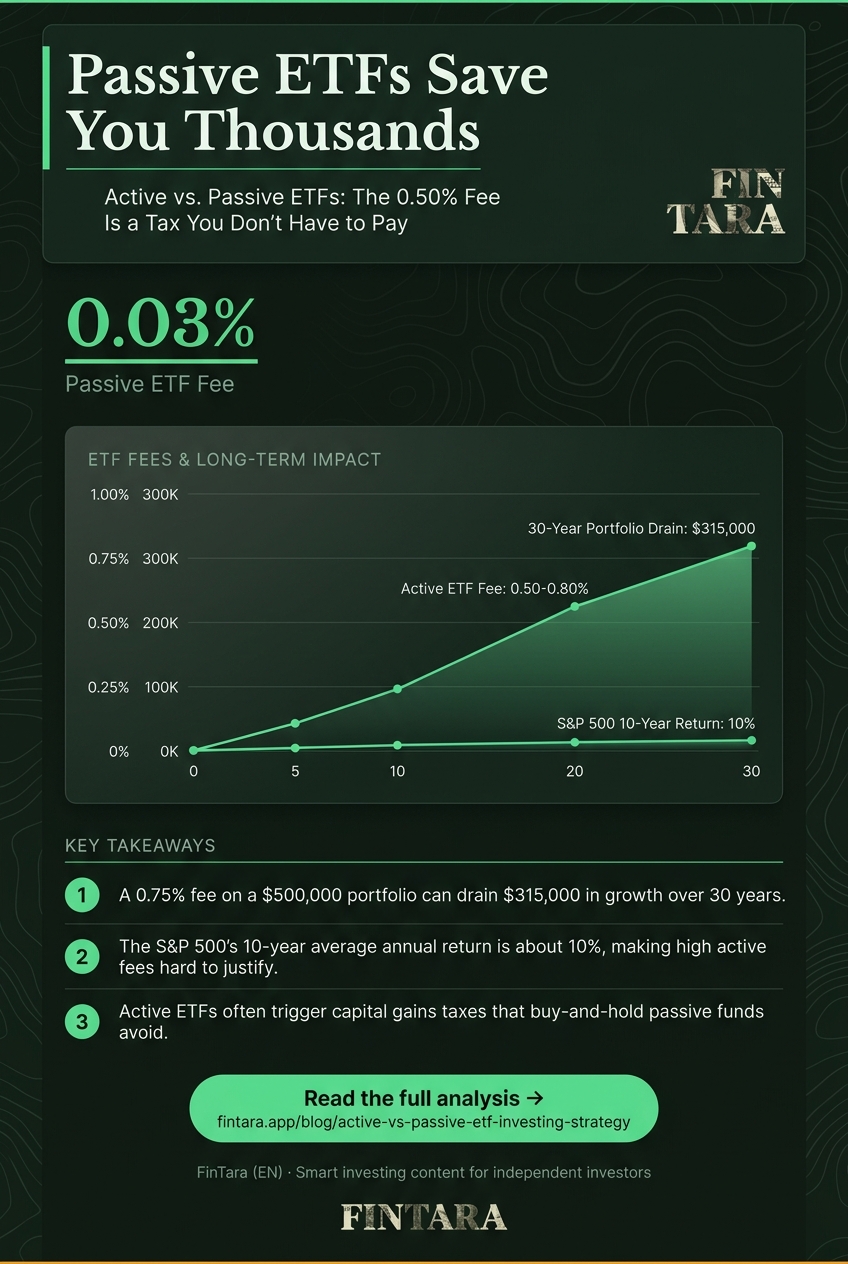
Passive ETFs like Vanguard’s VOO and iShares’ IVV charge 0.03% annually, while the average active ETF costs 0.50-0.80% as of 2023. Over 30 years, that fee gap compounds into a six-figure difference on a standard portfolio, even if the active manager never beats the market. The real cost isn’t just the expense ratio—it’s the behavioral trap of paying for skill that rarely materializes. For most retail investors building long-term wealth, the data points to a simple conclusion: passive wins on cost, consistency, and tax efficiency. Active ETFs have a narrow window of relevance, and it’s not where the marketing materials claim.
Why Active ETFs Fail the Cost-Benefit Test
The core promise of active ETFs is manager skill overcoming higher fees. The math rarely supports this. A 0.75% annual fee on a $500,000 portfolio costs $3,750 per year. Over 30 years, assuming a 7% annual return, that fee drains roughly $315,000 in compounding growth—money that never gets a chance to work for you.
Passive ETFs like VOO and IVV track the S&P 500 with 0.03% fees. The S&P 500’s 10-year average annual return is approximately 10% as of 2023. Even if an active manager ekes out an extra 1% annually (a rare feat), the fee drag erases most of that edge. The historical record is blunt: most active funds fail to match their benchmark over 10-year horizons. The gap widens in taxable accounts, where active managers’ higher turnover triggers capital gains distributions, creating tax bills you wouldn’t face with a buy-and-hold passive fund.
The inversion is critical: when you shouldn’t use active ETFs. If you’re a long-term, buy-and-hold investor with a 10+ year horizon, active ETFs almost always underperform on a net basis. The fee structure alone makes them a poor choice. The only exception is a specific, tactical scenario—which the next section defines.
Tax-Loss Harvesting: Where Active ETFs Can (Sometimes) Add Value
 Tax-loss harvesting adds meaningful after-tax returns only for high-bracket investors with large taxable portfolios, making active ETFs worthwhile primarily for that group. — Photo by RDNE Stock project on Pexels
Tax-loss harvesting is the one concrete advantage some active ETFs offer. In volatile markets, active managers can sell losers to offset gains, a maneuver passive ETFs can’t replicate because they track a fixed index. For high-net-worth investors in taxable accounts, this can defer taxes and improve after-tax returns.
The mechanism is straightforward: an active manager identifies underperforming holdings, sells them at a loss, and replaces them with similar (but not identical) securities to maintain exposure. This locks in a tax deduction while keeping the portfolio aligned with its strategy. A passive ETF, by design, can’t do this—it holds the index constituents until the index itself changes.
But here’s the catch: this advantage only materializes if the tax savings exceed the higher fees and potential underperformance. For most investors, the math doesn’t work. A 2023 study by Vanguard found that tax-loss harvesting added an average of 0.75% annually to after-tax returns—but only for investors in the highest tax brackets with significant unrealized gains. For everyone else, the benefit is negligible or negative after fees.
The inversion: when not to use active ETFs for tax-loss harvesting. If your portfolio is under $500,000 or you’re in a lower tax bracket, the complexity and higher fees of active ETFs likely outweigh any tax benefit. Stick with passive ETFs and harvest losses manually if needed.
Behavioral Biases: The Hidden Cost of Choosing Active

Investors don’t choose active ETFs because of data—they choose them because of psychology. The illusion of control, overconfidence, and recency bias all push retail investors toward active strategies, even when the numbers say otherwise.
The illusion of control makes us believe we can pick the right manager or time the market. Overconfidence leads us to think our judgment beats the crowd. Recency bias—favoring recent winners—drives flows into active funds after a strong year, even though past performance doesn’t predict future results. These biases cost real money. A 2022 DALBAR study found that the average equity fund investor underperformed the S&P 500 by 3.5% annually over 20 years, largely due to poor timing decisions driven by emotion.
Active ETFs exploit these biases. Their marketing emphasizes manager skill, proprietary models, and “alpha.” But the data shows most active managers fail to deliver consistent alpha after fees. The behavioral cost isn’t just emotional—it’s financial. Every dollar parked in an underperforming active fund is a dollar not compounding in a low-cost index fund.
The inversion: when to ignore the behavioral pull toward active. If you catch yourself thinking “this manager is different” or “I can time this active fund,” pause. Run the numbers. Compare the fee drag to historical performance. The bias is the trap; the data is the escape.
The Regulatory Shift: SEC Rule 6c-11 and the ETF Landscape
 The section key argument clarifies the next practical decision. — While SEC Rule 6c-11 spurred active ETF growth, the flood of new products created more noise than genuine value for retail investors. — Wikipedia contributors, via Wikimedia Commons
The SEC’s Rule 6c-11, implemented in 2019, standardized ETF structures and made it easier for active managers to launch ETFs. This regulatory change opened the floodgates for active ETF products, but it didn’t change the fundamental economics. Lower barriers to entry mean more competition, but also more noise.
Before 6c-11, active ETFs faced structural hurdles—many were mutual funds in ETF clothing, with daily disclosure requirements that hindered strategy execution. The new rule allowed full transparency or non-transparent structures, giving active managers flexibility. The result: a surge in active ETF launches, with assets growing from $100 billion in 2019 to over $500 billion by 2023.
But growth doesn’t equal success. The proliferation of active ETFs has made it harder for retail investors to separate signal from noise. More products mean more marketing, more complexity, and more fees. The regulatory shift benefited product providers more than investors. For retail investors, the lesson is to focus on what you can control: costs, tax efficiency, and behavioral discipline—not chasing the latest active fund launch.
The inversion: when to ignore new active ETF launches. If a fund is less than three years old, has less than $100 million in assets, or charges above 0.50%, it’s likely a marketing exercise, not a proven strategy. Wait for a track record, or stick with established passive funds.
What to Actually Do: A Passive-First Framework with Tactical Exceptions
Build your core portfolio around low-cost passive ETFs. Use VOO or IVV for U.S. large-cap exposure, with expense ratios of 0.03%. Add international exposure with funds like VXUS (0.07%) or emerging markets ETFs. Keep allocation simple: 60% U.S. equity, 30% international, 10% bonds or cash equivalents—adjust for your risk tolerance.
For tactical exceptions, consider active ETFs only in specific scenarios: high-tax-bracket investors with significant unrealized gains, or those seeking exposure to niche strategies (e.g., momentum, low-volatility) where passive replication is difficult. Even then, limit active ETFs to 10-20% of your portfolio. Monitor fees and performance quarterly. If an active ETF underperforms its benchmark net of fees for two consecutive years, replace it with a passive alternative.
The inversion: when not to use this framework. If you’re a professional trader with a proven edge, or you’re managing a portfolio under $50,000 where tax-loss harvesting is irrelevant, ignore the active ETF universe entirely. Complexity without benefit is a cost.
FAQ
What is the difference between active and passive ETF investing?
Active ETFs have managers making tactical decisions to beat the market, while passive ETFs track an index with minimal trading. Active ETFs charge higher fees; passive ETFs are cheaper and simpler.
Which has lower fees: active or passive ETFs?
Passive ETFs have lower fees. As of 2023, VOO and IVV charge 0.03%, while the average active ETF costs 0.50-0.80%. The fee gap compounds into significant long-term costs.
Do active ETFs outperform passive ETFs over the long term?
Historical data suggests most active ETFs fail to beat their benchmarks over 10-year periods after fees. The S&P 500’s 10-year average return is ~10%, and active managers rarely add enough alpha to offset higher costs.
How do taxes differ between active and passive ETF strategies?
Active ETFs may offer tax-loss harvesting advantages in volatile markets, but higher turnover often triggers capital gains distributions. Passive ETFs typically have lower turnover and better tax efficiency for buy-and-hold investors.
What are the best active ETFs for beginners?
Most beginners should avoid active ETFs due to higher fees and complexity. If you insist, consider established funds with low expense ratios and proven track records, but limit allocation to 10-20% of your portfolio.
How can I choose between active and passive ETFs for my portfolio?
Start with passive ETFs for core exposure. Add active ETFs only for specific tactical needs (e.g., tax-loss harvesting, niche strategies). Compare fees, track records, and tax efficiency before investing.
Can active ETFs work in a bull market?
Yes, but the fee drag remains. Even in strong markets, active managers must outperform by enough to cover their 0.50-0.80% fees and still beat passive alternatives. Most don’t.
Is there a role for active ETFs in retirement accounts?
Minimal. Retirement accounts are tax-advantaged, negating the tax-loss harvesting benefit. The fee disadvantage remains. Stick with passive ETFs in IRAs and 401(k)s.